
In one sentence
Choose baffle-box construction when even loft and stronger insulation matter most; choose sewn-through construction for a lower-profile, lighter or more affordable comforter. Fill type, fill amount and care still matter alongside the stitching.
Baffle box and sewn-through at a glance
| Decision factor | Baffle box | Sewn-through |
|---|---|---|
| Internal structure | Fabric walls connect the upper and lower shells | Stitches connect the upper and lower shells directly |
| Typical profile | Deeper, loftier chambers | Flatter quilted compartments |
| Warmth tendency | More room for fill to loft; often used for warmer tiers | Compressed stitch lines can reduce insulation at the seams |
| Fill control | Walls separate fill into three-dimensional chambers | Closed stitched shapes limit large-scale movement |
| Price tendency | Usually more complex and expensive to manufacture | Usually simpler and less expensive |
| Useful for | Cold rooms, high-loft down and an airy profile | Mild rooms, lighter weights and value-focused shopping |
Who each construction suits
Baffle box may suit you if…
You want a lofty down comforter, sleep in a cool room or dislike thin areas along stitch lines. It is also useful when warmth-to-weight matters more than the lowest purchase price.
Sewn-through may suit you if…
You prefer a flatter layer, sleep in a mild room or want a simpler build at a lower price. A light sewn-through comforter can also be easier to layer than a very lofty baffled model.
The structural difference is inside the comforter
A comforter starts with an upper shell, a lower shell and fill held between them. The grid you see from above is not merely decorative: it determines where those shells meet and how much vertical space the fill receives.
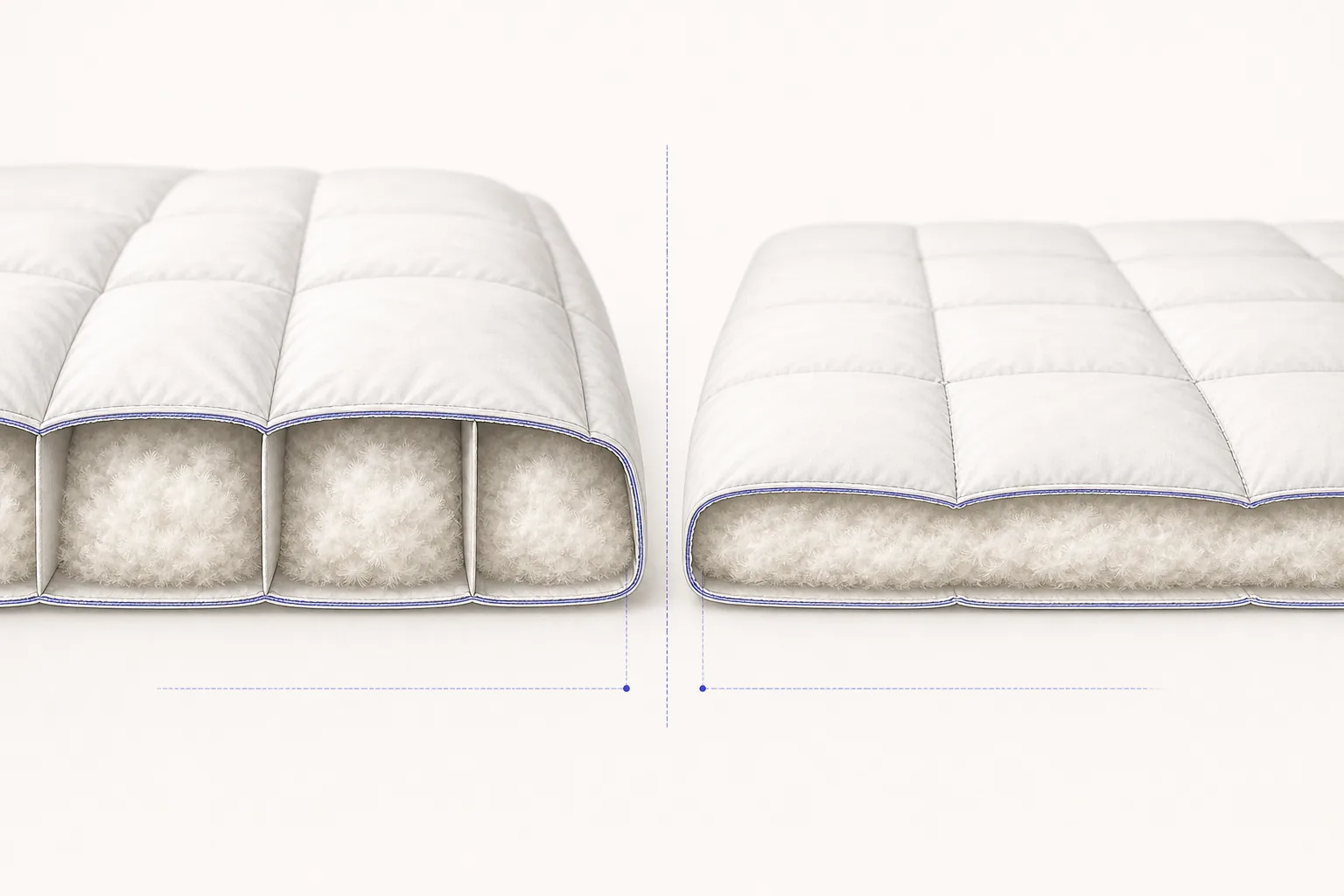
In baffle-box construction, narrow strips of fabric form internal walls between the upper and lower shells. Those walls create three-dimensional chambers. In sewn-through construction—also called box stitch or stitch-through—the needle passes through both shells and the fill, pulling the layers together at every grid line.
Our cutaway illustration exaggerates neither structure: the important cue is the continuous internal wall on the baffled side and the direct shell-to-shell meeting point on the sewn-through side. Product photos can hide that difference, so read the construction field rather than judging puffiness from styled photography.
How construction changes loft and warmth
Baffle walls give down clusters or synthetic fill more room to expand near chamber boundaries. That is why baffled designs are common in higher-loft and colder-room comforters. The Company Store and Puredown both describe the design as a way to support deeper, more even chambers.
Sewn-through stitching compresses the fill wherever the shells meet. Those narrow lines contain less insulation than the center of each compartment, which can produce cooler seams. That does not make every sewn-through comforter cold: a heavier fill can still be warmer than a lightly filled baffled model.
Construction is therefore a multiplier, not a warmth rating. Compare the actual warmth tier, fill weight and—when the fill is down—fill power. Our down comforter guide explains why a high fill-power number alone does not reveal the warmth of the finished product.
Fill movement, clumping and chamber design
Both designs divide fill into smaller areas, but neither guarantees perfect distribution. Baffle walls reduce movement between chambers while leaving room inside each chamber for the fill to shift. Sewn-through grids close each shape at the seam, yet fill can still collect within a square after washing or prolonged use.
Chamber size matters. Very large boxes give fill more space to migrate; extremely small boxes add more compressed stitch lines. Look for an even surface, intact seams and a construction description that matches the claimed warmth tier.
If an existing comforter has become uneven, do not assume the construction has failed. Complete drying and careful redistribution can restore loft when damp clusters are the cause. Shake and separate the fill gently rather than pulling aggressively at the shell.
The loftiest option is not always the lightest-feeling choice
Baffled comforters look deeper because the fill is allowed to rise. With efficient down, that loft can feel airy rather than heavy. Good Housekeeping’s construction explainer notes that baffled models can feel less dense even though they are often warmer overall.
A sewn-through comforter looks flatter, but physical weight depends on how much and what kind of fill sits inside it. A dense cotton or low-loft synthetic model can weigh more on the body than a lofty down comforter. Never translate visual thickness directly into pressure or warmth.
Hot sleepers should begin with a lightweight warmth tier and breathable shell, then use construction as a secondary filter. Cold sleepers should confirm adequate fill before paying a premium for baffles. Our guide to choosing a comforter puts those decisions in the right order.
Price and care trade-offs
Baffle-box construction requires additional internal fabric and assembly, so it often appears in higher-priced products. Sewn-through grids are simpler to make and widely used in budget and lightweight comforters. Price still reflects the shell, fill, sourcing and warranty as well as stitching.
Care instructions do not follow construction alone. Either design may be machine washable, dry-clean only or too large for a home drum. Baffled chambers can hold substantial wet fill, while sewn-through models can still clump if detergent remains or drying stops early.
Check the sewn-in care label and make sure the comforter can move freely in the machine. The safe comforter washing guide covers drum capacity, detergent, rinsing and complete low-heat drying without pretending one routine fits every fill.
How to identify the construction before buying
Online, search the specification table for baffle box, baffled, sewn-through, stitch-through or box stitch. Do not rely on the word quilted: it describes the visible stitching effect but may not explain whether internal walls exist.
In a store, gently separate the upper and lower shells beside an interior seam. A baffle leaves measurable space between them because a fabric wall bridges the gap. At a sewn-through line, both shells meet directly. Do not cut, stretch or damage the product to inspect it.
Finally, verify fill type, warmth tier, dimensions, care and returns. Construction helps you interpret a comforter; it does not replace the complete specification. Be cautious when a listing promises baffle-box performance but omits clear material and care details.
Frequently asked questions
What is a baffle box comforter?
It is a comforter with internal strips of fabric connecting the upper and lower shells. The strips form three-dimensional chambers that let the fill expand while limiting movement between boxes.
Source: The Company Store construction guide, Good Housekeeping Textiles Lab, Puredown construction guide
Is baffle box warmer than sewn-through?
It often supports more even loft and insulation because fill is not pinched flat at each grid line. But fill material, fill amount and warmth tier can outweigh construction, so a baffled model is not automatically warmer.
Source: The Company Store construction guide, Good Housekeeping Textiles Lab, Puredown construction guide
What is the difference between Bavarian and baffle box comforters?
Bavarian is sometimes used for sewn-through or box-stitch construction, where the shells meet directly. Baffle-box construction adds internal fabric walls, so check the maker’s diagram or specification instead of relying on the name alone.
Source: The Company Store construction guide, Good Housekeeping Textiles Lab, Puredown construction guide
What kind of comforter do 5 star hotels use?
There is no single hotel construction standard. Hotels choose for warmth, durability, laundering and replacement cost; consumers should compare those specifications rather than treating hotel-style wording as proof of baffle construction or quality.
Source: The Company Store construction guide, Good Housekeeping Textiles Lab, Puredown construction guide
Sources and editorial method
We checked definitions and practical distinctions against the sources below. Product recommendations live in separate buying guides with their own criteria and disclosures.
The bottom line
Baffle box is the stronger starting point for high loft and even cold-room insulation. Sewn-through is a rational choice for a flatter, lighter or less expensive comforter. Make the final decision with fill amount, warmth tier, shell and care—not stitching alone.