

Quick answer
Check the care label first. If machine washing is allowed, use a roomy front-loader, mild detergent, a gentle cycle and an extra rinse. Dry fully on low heat, redistributing the fill several times. Never cram a king comforter into a small washer.
Comforter care by fill
| Fill | Wash | Dry | Main risk |
|---|---|---|---|
| Down | Gentle, cold or warm; down-safe detergent | Low heat until completely dry | Damp clumps and mildew |
| Down alternative | Gentle; mild detergent | Low heat | Heat-damaged fibers |
| Cotton | Follow label; often warm gentle | Low to medium if allowed | Shrinkage |
| Wool | Usually spot clean or wool cycle only | Air dry flat | Felting and shrinkage |
Before it goes in the washer
Read the sewn-in label, inspect seams and pre-treat isolated stains. Remove a duvet cover and close any small tears before agitation makes them larger.
The drum-size test is simple: the dry comforter should fit loosely, not as a compressed ball. If you have to push hard to close the door, use a commercial washer.
- Photograph the care label before washing.
- Use a small amount of mild liquid detergent.
- Skip fabric softener; it can coat fill fibers.
- Wash the comforter by itself for balanced rinsing.
The safest machine-washing method
Select a bulky-bedding or gentle cycle with cold or warm water, unless the label says otherwise. Add detergent sparingly: excess soap is difficult to rinse from thick fill.
Run an extra rinse. When the cycle ends, support the comforter with both arms rather than lifting one wet corner, which can pull at baffle seams.
- Large-capacity front-loader
- Gentle or bulky-bedding cycle
- Cold or warm water
- Extra rinse with no added detergent
How to wash a down comforter
Down is washable only when the care label says so. Use a large front-loading machine without a center agitator, a small amount of down-specific or mild detergent and the gentlest suitable cycle. An extra rinse matters because detergent residue can bind down clusters and reduce loft.
Support the wet comforter evenly when moving it. Do not twist or wring it. If the shell is torn, the baffles are failing or the item cannot move freely in the drum, stop and use a cleaner experienced with down bedding.
- Confirm the label permits washing.
- Use enough drum space for free movement.
- Rinse until no detergent remains.
- Plan several hours for complete low-heat drying.
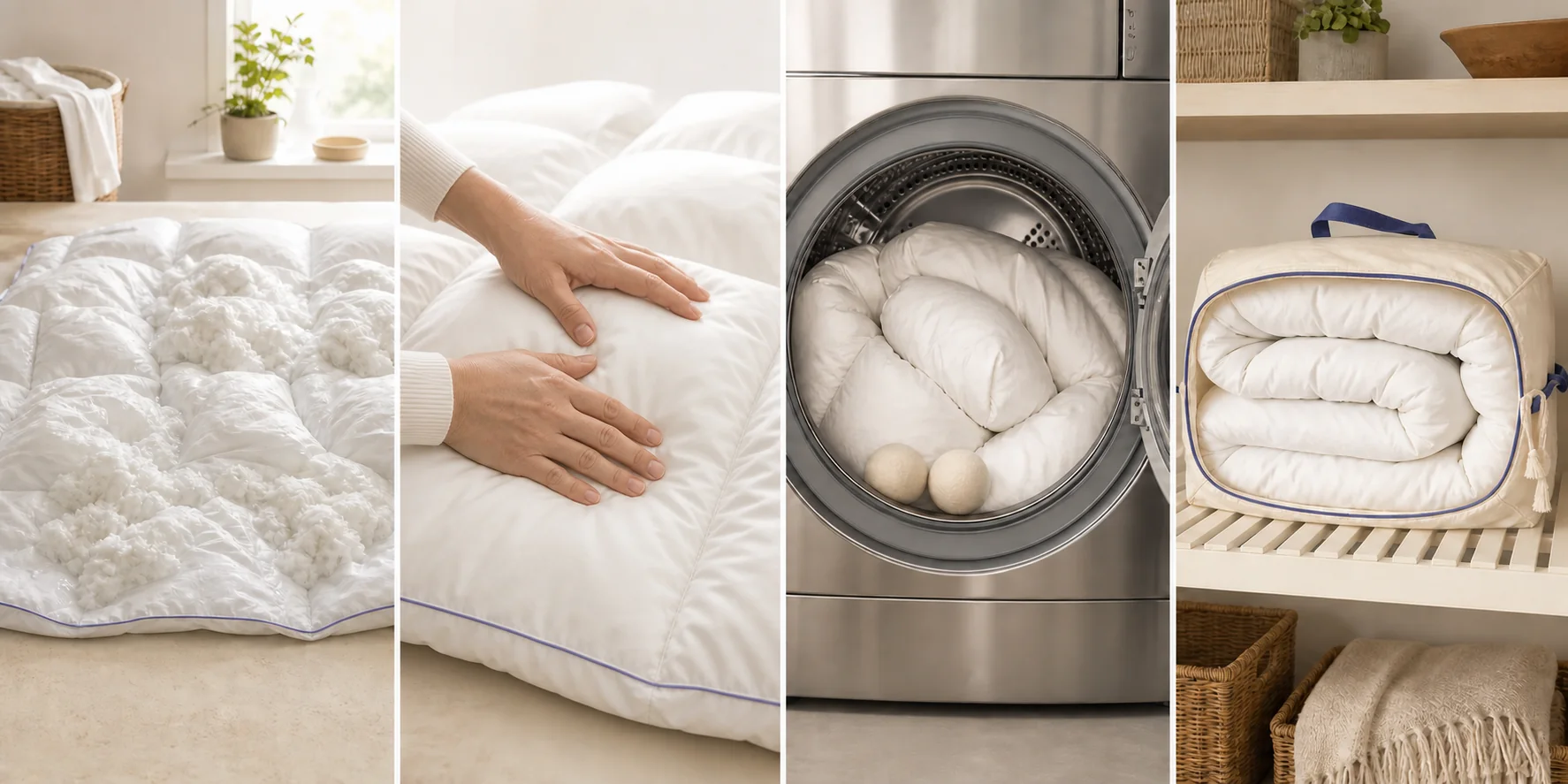
Dry it completely—not just on the surface
A comforter can feel dry outside while damp fill remains in the center. Use low heat, pause every 30 to 45 minutes, shake it out and break apart clumps by hand.
Down may take several hours. Clean dryer balls help restore loft. Stop only when every baffle feels light, separate and dry; lingering moisture can create odor or mildew.
- Use low heat, not a hot shortcut.
- Reposition the comforter repeatedly.
- Check inner baffles for cool or damp spots.
- Let it air for another hour before making the bed.
Drying time is a condition, not a timer
Dryer capacity, spin speed, fill type and comforter size make a universal minute estimate unreliable. The safe endpoint is physical: no cool center, no heavy baffle, no damp odor and no fill clumps anywhere.
If the label permits tumble drying, use low heat and inspect every 30 to 45 minutes. If it permits air drying only, spread the item with strong airflow and turn it often; do not leave dense wet fill folded over a rail.
- Surface fabric dries before inner fill.
- Low heat takes longer but reduces heat damage risk.
- Repeated redistribution prevents persistent clumps.
- Return it to the bed only when fully dry.
When home washing is the wrong choice
Take the comforter to a professional when the label says dry clean only, the shell is delicate, the fill is wool without a washable claim, or the item has damaged baffles.
A laundromat is often better than a dry cleaner for a machine-washable king comforter: you get the drum capacity without introducing dry-cleaning solvents.
- Dry-clean-only care label
- Silk shell or specialty fill
- No washer with enough drum space
- Large tears, loose baffles or significant staining
Frequently asked questions
Can you wash a comforter in a washing machine?
Usually, yes, when the care label permits machine washing and the comforter moves freely in the drum. A cramped washer cleans poorly and can stress seams, so use a large-capacity front-loader or commercial machine for bulky queen and king comforters.
Source: Whirlpool, Maytag, Maytag down-comforter care, The Company Store
Can you put a comforter in the dryer?
Most synthetic and many down comforters can tumble dry on low, but the care label wins. Dry completely, pause to redistribute the fill, and use clean dryer balls for down. Air-dry wool or any item whose label rules out tumble drying.
Source: Whirlpool, Maytag, Maytag down-comforter care, The Company Store
Can you wash a down comforter in the washing machine?
Yes, when its sewn-in label permits machine washing and the drum is large enough for free movement. Use a gentle or bulky cycle, a small amount of down-safe detergent and an extra rinse; otherwise use a suitably equipped professional cleaner.
Source: Whirlpool, Maytag, Maytag down-comforter care, The Company Store
Can you put a feather down comforter in the dryer?
Many can be tumble-dried on low when the care label allows it. Pause repeatedly to separate damp clumps and continue until the center of every baffle is completely dry. High heat can damage the shell or fill.
Source: Whirlpool, Maytag, Maytag down-comforter care, The Company Store
Is it better to wash or dry clean a down comforter?
Follow the product label rather than a universal rule. Some down comforters are designed for careful machine washing, while dry-clean-only shells, damaged baffles or oversized items need professional care.
Source: Whirlpool, Maytag, Maytag down-comforter care, The Company Store
How long does it take to dry a full-size comforter?
There is no fixed safe time: machine size, fill and retained water change the result. A bulky comforter can take several low-heat cycles. Stop by checking every inner section for cool, damp or clumped fill, not by the timer alone.
Source: Whirlpool, Maytag, Maytag down-comforter care, The Company Store
What if my comforter is too big for my washer?
Do not force it in. Use a large-capacity machine at a laundromat or a professional cleaner experienced with the fill. The comforter needs room to circulate, rinse and avoid uneven strain.
Source: Whirlpool, Maytag, Maytag down-comforter care, The Company Store
How often should you wash a comforter?
With a duvet cover or top sheet, one or two deep washes per year is often sufficient. Wash sooner after spills, illness or visible soil, and follow the product label. Covers and sheets should be washed much more frequently.
Source: Whirlpool, Maytag, Maytag down-comforter care, The Company Store
Sources and methodology
We cross-checked practical guidance against manufacturer care instructions and established editorial or standards sources. Always follow the sewn-in care label on your own product.