
In one sentence
A King comforter can work on a Queen bed when you want more side coverage, but calculate the drop first: subtract the 60-inch Queen mattress width from the comforter width and divide by two.
Example King comforter widths on a 60-inch Queen mattress
| Comforter width | Theoretical drop per side | Likely use |
|---|---|---|
| 90 in | 15 in | Similar to a generous Queen; may still expose a deep foundation |
| 96 in | 18 in | Balanced oversized look on many deep Queen mattresses |
| 104 in | 22 in | Long side coverage; check bed height carefully |
| 108 in | 24 in | Can approach the floor on low frames |
| 112 in | 26 in | Very oversized; laundry and pooling become major concerns |
Who should—and should not—size up
A King may suit you if…
Your Queen mattress is deep, two sleepers pull the comforter sideways, or you want to conceal more of the foundation.
Stay with Queen if…
The bed is low, the room is tight, you dislike floor contact or your washer already struggles with Queen bedding.
The drop formula predicts the look better than the label
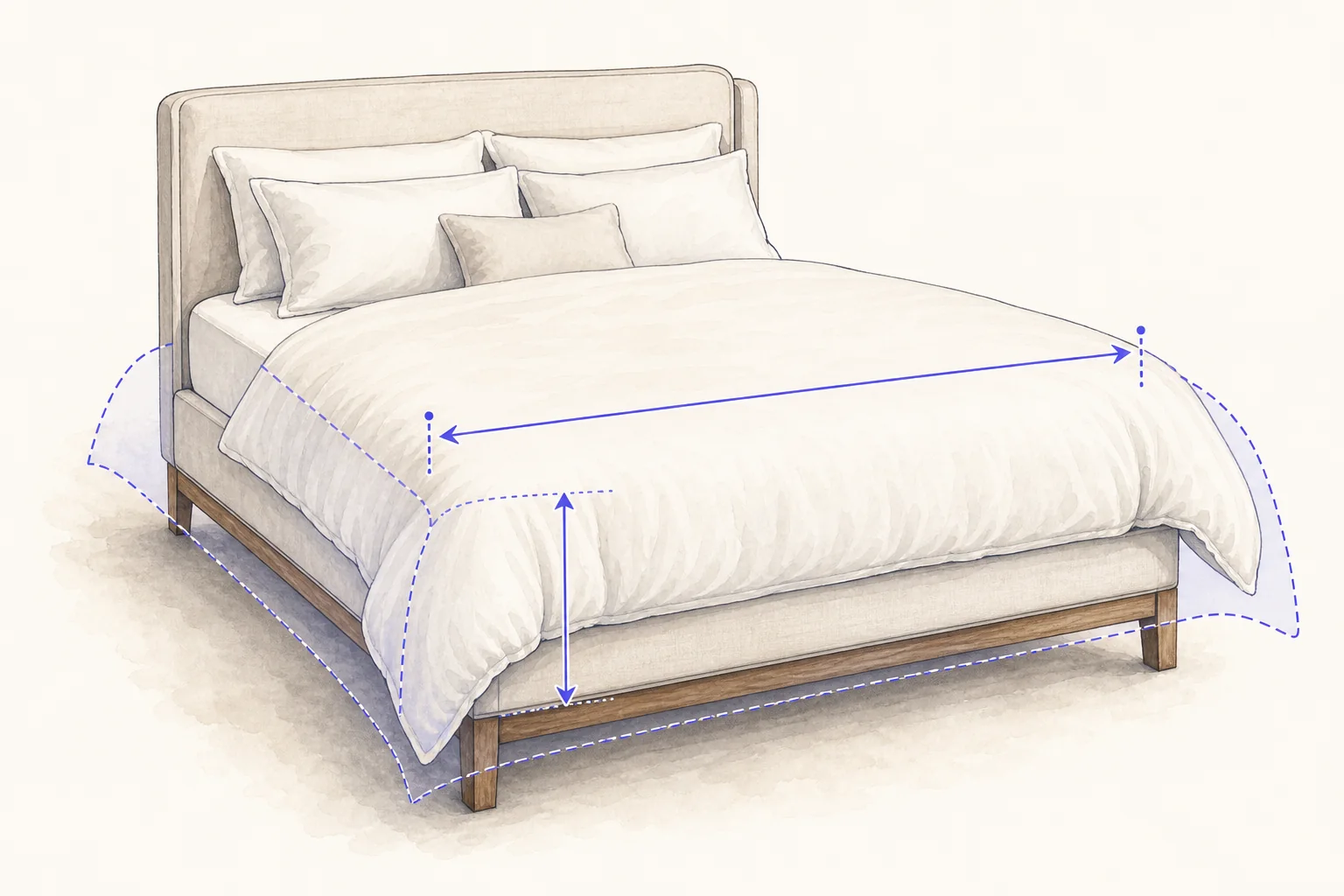
Queen mattresses are commonly about 60 inches wide. If a King comforter is 104 inches wide, the simple theoretical side drop is (104 − 60) ÷ 2, or 22 inches per side.
The real drop will be shorter once the comforter rises over sleepers and loft. Still, this calculation reveals whether the product is in a useful range before you buy. The size-drop calculator handles the same arithmetic with your measurements.
What a King comforter looks like on a Queen bed
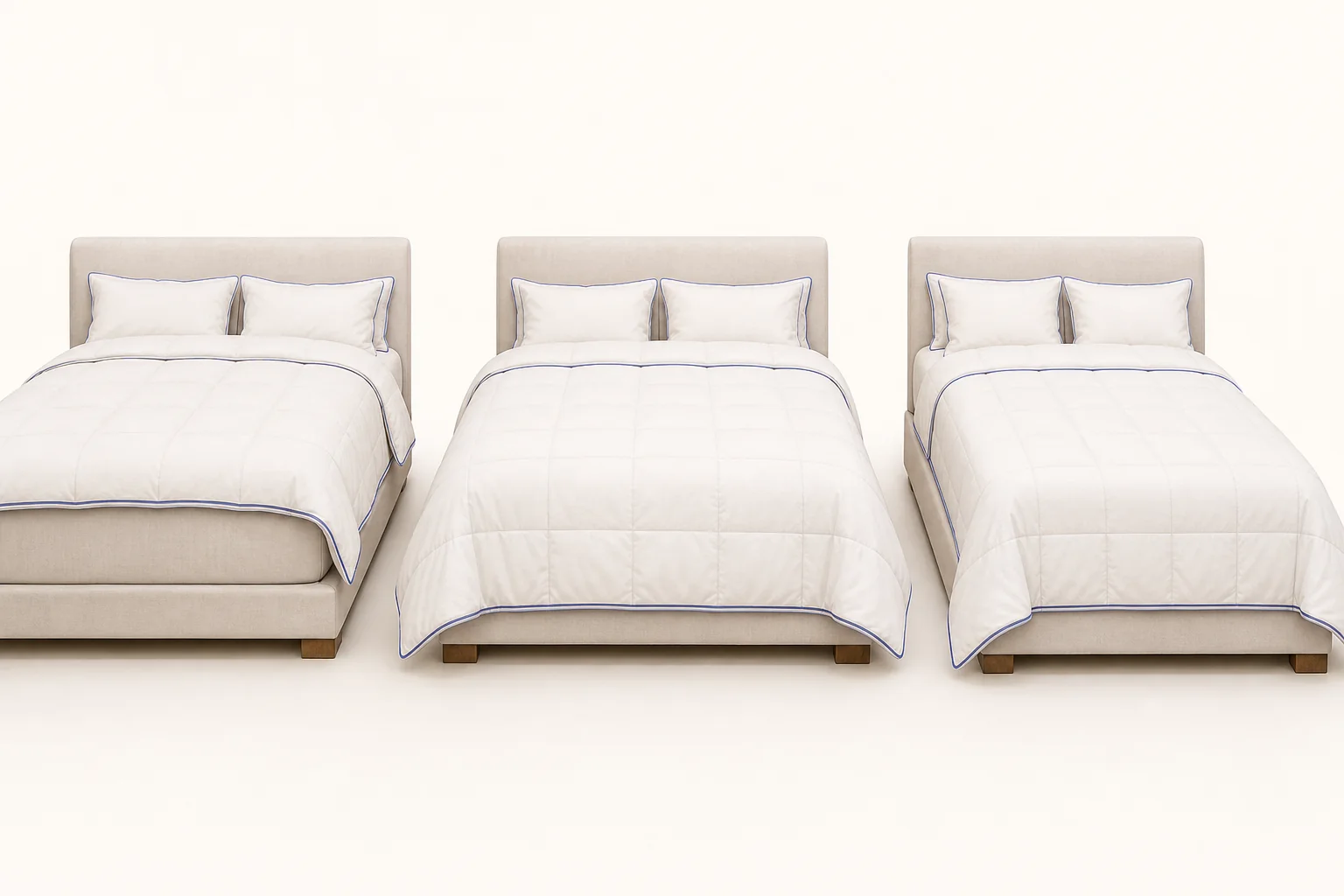
A moderately wider King can create an intentionally full, hotel-like silhouette. It covers more of the mattress and foundation and reduces the chance that one sleeper pulls the entire layer away from the other.
An extremely wide model can look like a bedspread, hide the frame or touch the floor. The visual is not universally better: it depends on frame height, mattress thickness and whether you want a tailored or relaxed finish.
Queen versus King comforter is not one fixed measurement
Sleep Foundation publishes broad ranges because manufacturers vary. Queen comforters commonly span roughly 86–90 inches in width, while King products can range from about 90 to 108 inches or beyond.
That overlap is why a small King may fit a Queen better than an oversized Queen from another brand. This page owns the Queen-versus-King decision; the generic comforter size chart remains the source for all size ranges.
Check length separately from width
Sizing up mainly adds width, but the King comforter may also be longer. Compare product length with the Queen mattress's roughly 80-inch length and decide where the comforter begins below your pillows.
Too much foot drop can bunch against a bench or floor. Too little length can still leave the mattress exposed even when the sides look generous. Never infer length from width.
A King comforter does not belong in a Queen duvet cover
Using a King comforter directly on a Queen bed is a styling choice. Stuffing that larger comforter into a smaller Queen cover is a different experiment: it can compress fill, bunch chambers and strain seams or closures.
Match an insert and cover by finished dimensions, allowing only a small intentional difference when the maker recommends it. Corner ties cannot correct a large mismatch.
The hidden trade-off is laundry and storage
A King comforter holds more shell fabric and often more fill. It occupies more washer and dryer volume when wet and needs more closet space. A machine-washable label does not prove it can move freely in your home drum.
Before sizing up, review the comforter washing guide and storage guide. If the larger layer requires commercial laundry every time, decide whether the extra drop is worth that recurring friction.
Frequently asked questions
Is a King comforter too big for a Queen bed?
Not automatically. A 96- to 104-inch width can create useful extra drop on many Queen beds, while a very wide model may pool on a low frame. Calculate using the finished dimensions.
Source: Sleep Foundation comforter sizes, Byourbed bedding dimensions, Purple comforter size guide
Do people put King comforters on Queen beds?
Yes. Common reasons are deeper mattresses, more coverage for two sleepers and a fuller visual style. It is optional rather than a fit requirement.
Source: Sleep Foundation comforter sizes, Byourbed bedding dimensions, Purple comforter size guide
Should you buy a comforter one size bigger than your bed?
Only when the measured drop solves a real coverage problem. Sizing up also increases floor contact, purchase cost, laundry volume and storage needs.
Source: Sleep Foundation comforter sizes, Byourbed bedding dimensions, Purple comforter size guide
What does it look like when you put a King comforter on a Queen bed?
It usually creates a longer side drop and may hide more of the foundation. The exact look depends on comforter width, mattress depth, frame height and how much loft is lifted by sleepers.
Source: Sleep Foundation comforter sizes, Byourbed bedding dimensions, Purple comforter size guide
Sources and editorial method
We checked definitions and practical distinctions against the sources below. Product recommendations live in separate buying guides with their own criteria and disclosures.
The bottom line
A King comforter can be an excellent oversized layer on a Queen bed, but only when its measured drop fits your frame and routine. Use width, length and machine capacity—not the size name alone—to decide.