In one sentence
Choose wool when you value moisture management and a flatter, gently weighted feel; choose down when maximum loft and warmth-to-weight matter most—then verify fill content, warmth tier and care rather than trusting the material name alone.
Wool and down comforters at a glance
| Decision | Wool fill | Down fill |
|---|---|---|
| Typical feel | Flatter, denser and gently weighted | Lofty, airy and compressible |
| Warmth-to-weight | Moderate | Often high, depending on fill power and amount |
| Moisture behavior | Wool fibre can absorb moisture vapor | Shell and ventilation strongly affect comfort |
| Specification to check | Wool percentage and fill weight | Down percentage, fill power and fill weight |
| Care | Often spot, gentle or professional care | Some washable; thorough low-heat drying is critical |
| Animal material | Sheep fleece | Waterfowl undercoating |
Who each natural fill suits
Wool may suit you if…
You like a flatter layer with some body, experience changing humidity, and are comfortable following a potentially more restrictive care label.
Down may suit you if…
You want high loft with low physical weight, sleep in a cool room, and can maintain a fill that needs careful washing and complete drying.
The fibres create different bed feel
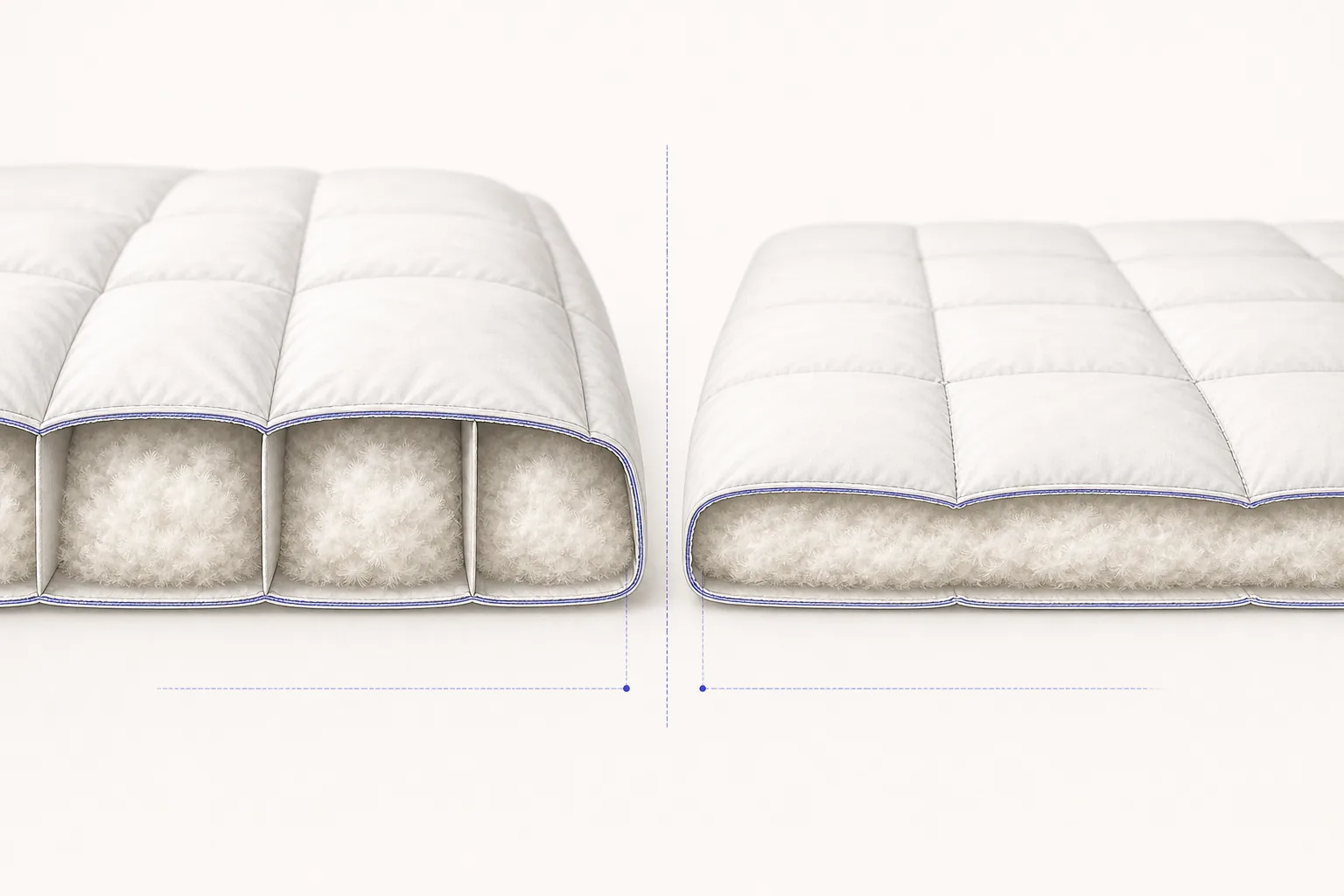
Wool fill is carded into bats or layers, so a wool comforter generally drapes with a flatter and more substantial feel. Down consists of three-dimensional clusters from the soft undercoating of waterfowl; those clusters expand and trap air, producing visible loft.
Neither feel is a quality verdict. Some sleepers enjoy the gentle pressure of wool, while others want an airy down layer. Shell fabric, fill amount and stitching can change both profiles, so compare finished weight and construction as well as fill name.
Down often leads in warmth-to-weight; total fill still matters
The American Down and Feather Council defines fill power as loft, expressed as cubic inches per ounce. Higher fill power means a given ounce occupies more space, but it does not reveal how many ounces are inside the comforter. A lower-fill-power model with much more fill may be warmer.
Wool does not use fill power. Compare the maker's warmth tier and fill weight for the exact size. A wool comforter can be very warm, but it usually feels heavier than a down model designed for similar cold conditions.
Moisture management is wool's clearest material advantage
Woolmark describes wool fibre as able to manage moisture vapor and respond to changing temperature. That can make wool appealing in humid or variable conditions, but it does not make every wool comforter actively cooling. A heavy wool fill can still be too warm.
Down comfort depends heavily on warmth tier, shell permeability and room conditions. Hot sleepers should choose a genuinely light fill rather than assuming a premium down cluster will cool them. Our winter comforter guide is for cold-room priorities; warm sleepers should start at the opposite end of the range.
Material names do not prove hypoallergenic performance
A reaction can involve the animal fibre, residual contaminants, shell, detergent or dust mites. Down and wool labels alone cannot diagnose or prevent allergy. Seek medical advice for significant symptoms and prioritize a washable setup when environmental allergens are a concern.
Read precise content claims. FTC guidance says down percentage and species claims must be truthful and substantiated, while household wool textiles are subject to fibre labeling requirements. A vague natural-fill claim is not enough.
Both fills punish the wrong care routine
Many wool comforters call for airing, spot cleaning, gentle washing or professional care because agitation and heat can felt or shrink fibres. Some are machine washable, but only the sewn-in label settles the question for a specific product.
Down can clump while wet and needs abundant drum room plus complete low-heat drying. Tennis or dryer balls may help separate clusters if the label permits. Never store either fill damp, and do not force a large comforter into a packed washer.
Compare a specification stack, not a material story
For wool, record wool percentage, fill weight for the listed size, shell fibre, construction, finished weight and care. For down, record down percentage, species claim, fill power, fill weight, chamber construction, shell and care. Ethical or environmental claims need their own named certification and scope.
Then compare dimensions and return terms. A premium fill cannot compensate for inadequate side coverage or a care routine you cannot follow. Our best wool comforter and best down comforter guides keep product evaluation separate from this material decision.
Frequently asked questions
What is the healthiest material for a comforter?
There is no universally healthiest fill. Comfort depends on warmth, moisture, sensitivities and cleanability; significant allergy or respiratory concerns should be discussed with a qualified clinician.
Source: Woolmark: wool fibre properties, American Down and Feather Council terminology, FTC down advertising and labeling guidance, FTC textile and wool labeling guide
What are the disadvantages of a wool duvet?
Wool is usually flatter and heavier than down for comparable warmth, may have restrictive care instructions, and can shrink or felt if washed incorrectly. Some sleepers simply prefer a loftier feel.
Source: Woolmark: wool fibre properties, American Down and Feather Council terminology, FTC down advertising and labeling guidance, FTC textile and wool labeling guide
What kind of comforter do 5 star hotels use?
There is no single five-star standard. Hotels choose different down, feather, synthetic and blended products based on climate, laundering, durability and cost; hotel-style language is not a material specification.
Source: Woolmark: wool fibre properties, American Down and Feather Council terminology, FTC down advertising and labeling guidance, FTC textile and wool labeling guide
Which is better, wool or goose down?
Wool is the stronger fit for moisture management and a flatter weighted feel. Goose down can provide greater loft and warmth for less weight. The better option is the one whose warmth, dimensions and care suit your room and routine.
Source: Woolmark: wool fibre properties, American Down and Feather Council terminology, FTC down advertising and labeling guidance, FTC textile and wool labeling guide
Sources and editorial method
We checked definitions and practical distinctions against the sources below. Product recommendations live in separate buying guides with their own criteria and disclosures.
The bottom line
Wool and down solve warmth differently: wool offers a flatter, moisture-managing layer; down offers exceptional loft and warmth-to-weight. Demand complete fill, construction and care specifications before paying for either name.