
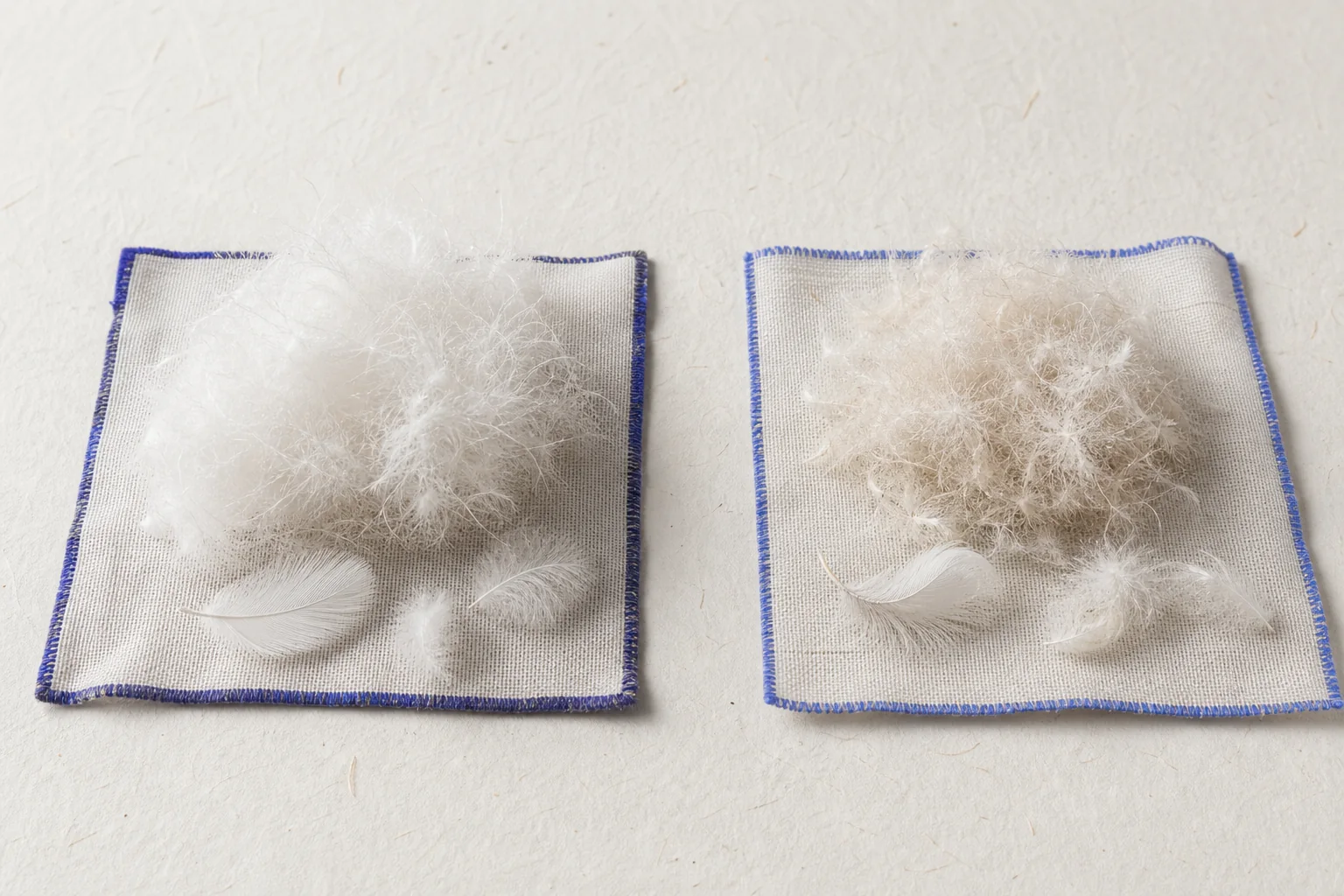
In one sentence
Neither species is automatically warmer: compare fill power, fill weight, down percentage, construction and certified sourcing first; use goose versus duck as a secondary filter.
Goose down and duck down at a glance
| Decision | Goose down | Duck down | What to verify |
|---|---|---|---|
| Warmth | Can reach very high loft | Can also provide high loft | Fill power plus total fill weight |
| Weight | High-loft grades can use less fill for a target warmth | Depends on the stated loft and fill amount | Finished product weight and warmth tier |
| Price | Usually positioned at a premium | Often the lower-cost route | Actual specification, warranty and return terms |
| Odor | Quality and cleaning matter | Quality and cleaning matter | Cleanliness, care directions and return policy |
| Sourcing | Species does not prove welfare | Species does not prove welfare | RDS or another independently verified standard |
Who each fill can suit
Goose down can suit
Buyers seeking maximum loft at low weight who can justify a premium after comparing like-for-like specifications.
Goose down may not suit
Value-focused shoppers or anyone treating the species name as a substitute for fill power, fill weight and sourcing evidence.
Duck down can suit
Buyers who want natural-down loft at a broader range of prices and are willing to compare the actual fill specification.
Duck down may not suit
Anyone unable to verify cleaning, composition, sourcing or an adequate return policy for the specific product.
Is goose down or duck down warmer?
Species alone does not set warmth. Fill power describes the loft produced by a measured amount of down, while fill weight tells you how much filling is present. Construction then determines how evenly that insulation stays across the bed.
Goose down is available at exceptionally high fill powers, which helps explain its premium reputation. That does not make every goose-down comforter warmer: a high-loft duck-down product with enough fill can be warmer than a lightly filled or lower-grade goose-down product.
- Compare fill power only within the same test convention.
- Do not confuse a higher fill-power number with more total warmth.
- Check baffle-box or sewn-through construction for likely cold spots.
- Match the stated warmth tier to your room and sleep temperature.
Why goose down usually costs more
Very large, high-loft goose clusters are scarcer, and premium brands commonly reserve goose down for their highest specification tiers. Duck down is more widely available and therefore often offers a lower entry price.
Price is not proof of performance. Compare like for like: shell fabric, down percentage, fill power, fill weight, dimensions, warranty and return terms. Marketing phrases such as European, luxury or hotel quality are not substitutes for those numbers.
Read the label beyond the species name
Down is the fine insulating layer beneath tougher exterior feathers. A comforter may contain down clusters, feathers or a stated blend, so confirm the down percentage rather than assuming that a down label means cluster-only filling.
IDFL's published labeling guidance shows that species claims and fill composition are separately defined. In practical shopping terms, check both: a goose claim tells you the species proportion, while the down percentage tells you how much of the fill is down rather than feather components.
Sourcing matters for both duck and goose down
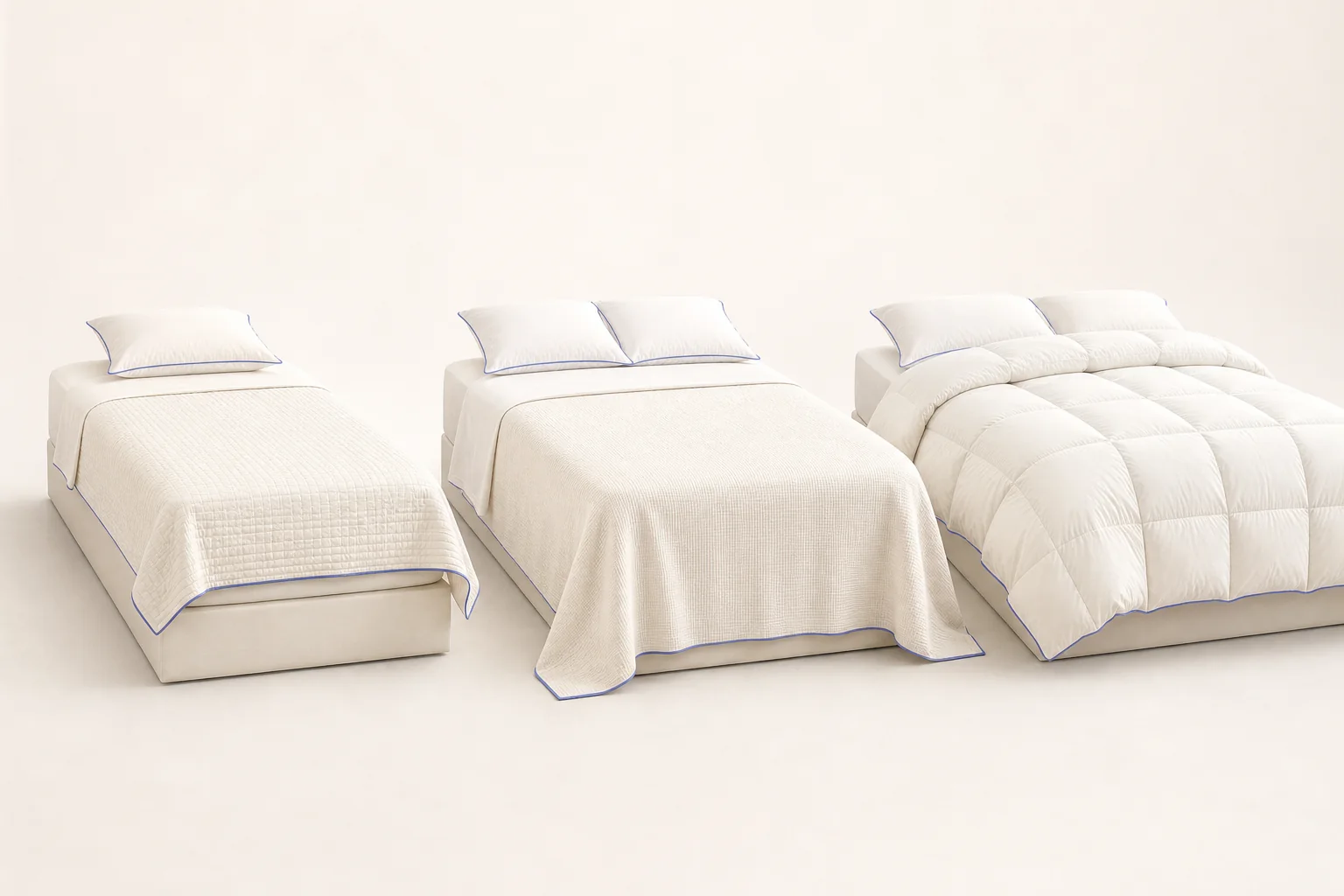
Neither species label verifies animal welfare. Textile Exchange says its Responsible Down Standard covers both ducks and geese, prohibits live plucking and force-feeding, and uses third-party audits plus chain-of-custody requirements.
Look for a product-level certification claim you can verify. A brand-wide sustainability statement is not necessarily evidence that the exact comforter is certified. Recycled down can reduce demand for virgin material, but traceability may differ, so read the specific claim carefully.
A five-check buying sequence
Start with warmth need and room temperature, then compare fill power and fill weight together. Check the down percentage and construction, verify dimensions and care, and finally confirm sourcing evidence and return terms.
If two comforters remain genuinely comparable on those points, goose versus duck can break the tie: choose goose for access to the highest loft tiers or duck for value. If the specifications are incomplete, the species name should not rescue the product.
Frequently asked questions
Is goose down or duck down warmer?
Neither is inherently warmer in every product. Compare fill power, fill weight and construction together; a high-specification duck-down comforter can be warmer than a lower-grade or lightly filled goose-down one.
Source: Textile Exchange — Down, Textile Exchange — Responsible Down Standard, IDFL — European labeling standards
What is more expensive, duck or goose?
Goose down is usually more expensive, especially at very high fill powers. Scarcity and premium positioning contribute, but price alone does not establish warmth or quality.
Source: Textile Exchange — Down, Textile Exchange — Responsible Down Standard, IDFL — European labeling standards
Does duck down smell more than goose down?
Species alone is not a reliable odor test. Processing, cleanliness, moisture, storage and care all matter. Check the product's return policy and follow its drying instructions completely.
Source: Textile Exchange — Down, Textile Exchange — Responsible Down Standard, IDFL — European labeling standards
Is goose down more ethical than duck down?
Not by species alone. Look for independently verified product-level sourcing such as the Responsible Down Standard, which covers both ducks and geese and addresses welfare and chain of custody.
Source: Textile Exchange — Down, Textile Exchange — Responsible Down Standard, IDFL — European labeling standards
Sources and editorial method
We checked definitions and practical distinctions against the sources below. Product recommendations live in separate buying guides with their own criteria and disclosures.
The bottom line
Choose the comforter with the clearer, better-matched specification. Goose down can justify its premium at exceptional loft; duck down can be the smarter value when fill power, fill weight, construction and sourcing all check out.