
Couples bedding
3 Best Comforters for Couples [2026]
The best setup depends on whether you share the same warmth preference, need two temperature zones, or would sleep better under separate layers.
Disclosure: The Duvet Advisor is reader-supported. When you buy through links on our site we may earn an affiliate commission, at no extra cost to you. We only recommend products after comparing published expert research, verified specifications and clearly cited sources. How this works.
Quick take
If one partner sleeps warmer than the other, a dual-zone comforter or two separate single-size layers is more adaptable than compromising on one all-season fill. Kömforte is the clearest single-piece dual-zone option, Bedsure suits couples who both want a lighter cool-touch layer, and Utopia Bedding is the straightforward value choice when both partners share a moderate warmth preference. Measure the bed and desired side coverage, confirm the exact variant and care label, and treat separate duvets as a valid alternative rather than a product failure.
Shortlist
3 comforters worth comparing
These are comparison candidates, not products we claim to have personally tested. Ratings are listing snapshots and can change; Amazon may combine reviews across sizes, colors or related variants.
Kömforte Dual Zone Comforter
Best for: Couples who want one shared comforter but one person prefers noticeably more insulation.
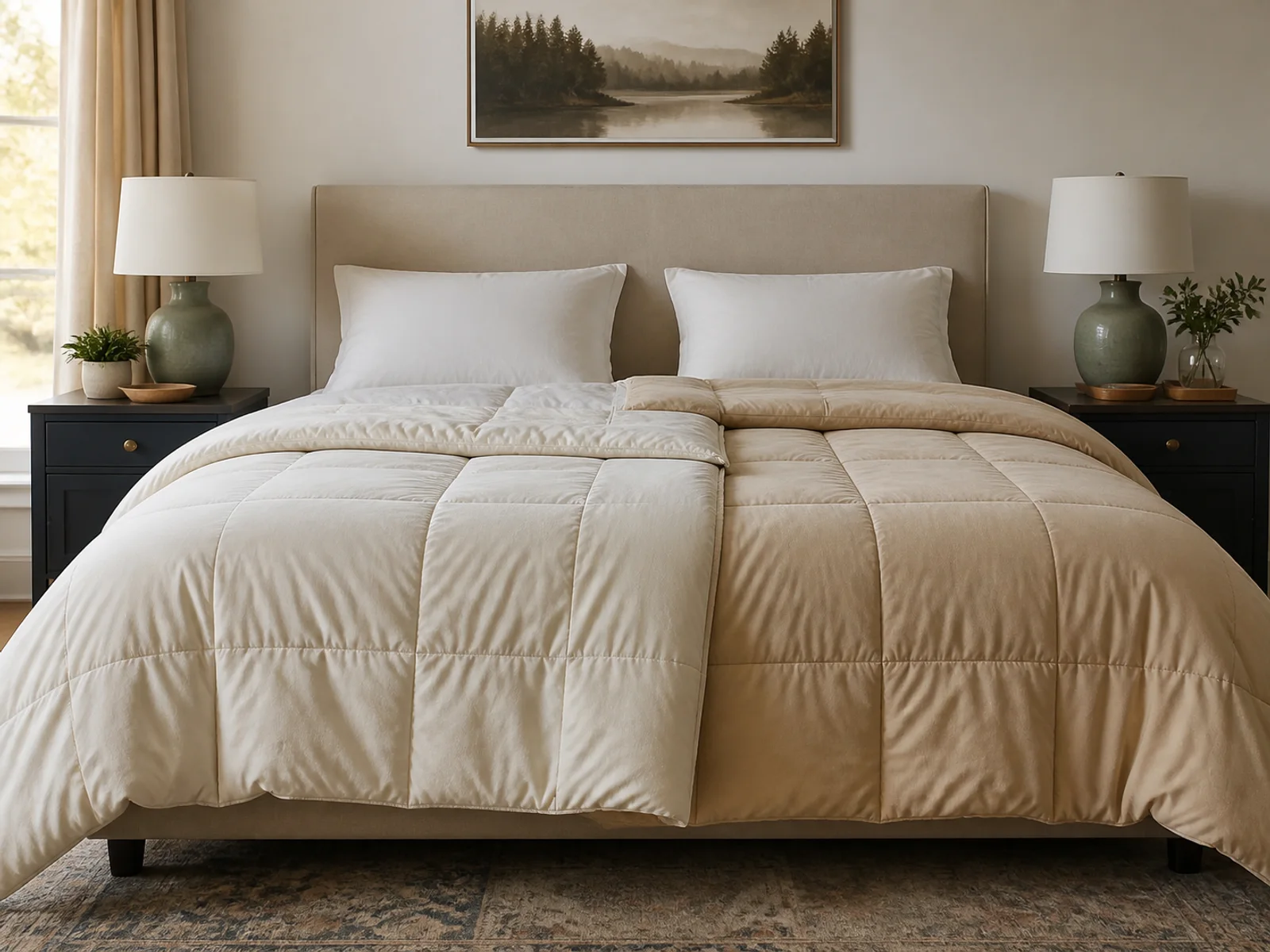
The maker publishes two fill zones: 150 grams of microfiber on the lighter side and 300 grams on the warmer side, with labeled tabs. Queen/Full is listed at 90 by 90 inches and King/California King at 106 by 93 inches. The limitation is fixed left-right zoning: it cannot independently change through the night, and rotating the comforter swaps the sides.
Amazon review context · checked 2026-08-30
We did not use the maker's reviews or an unstable Amazon rating. Selection is based on the current published zone weights, dimensions, materials and care information; this is not hands-on thermal testing.
by SöMN — Kömforte specificationsPaid link · Check current rating, seller, variant and price
Bedsure Cooling Comforter
Best for: Couples who both prefer a lightweight layer and a cool initial hand feel.
The current listing positions this as a lightweight, dual-sided cool-touch synthetic comforter. It is not a two-zone product: both sleepers receive the same construction. A cool-touch shell does not actively lower room temperature and may feel slicker than conventional cotton-like fabric.
Amazon review context · checked 2026-08-30
We do not reproduce changing star scores or review totals. The recommendation is limited to the current published construction and warm-room scenario.
Official Amazon listing — Bedsure B0CMTYMSQ1Paid link · Check current rating, seller, variant and price
Utopia Bedding All-Season Duvet Insert
Best for: Couples with similar warmth needs who want a washable insert with corner tabs.
The current listing identifies a microfiber shell, polyester fill, box stitching, corner tabs, cold machine washing and no-heat tumble drying. It is a conventional single-weight insert, so it is the wrong compromise when one partner regularly overheats and the other stays cold.
Amazon review context · checked 2026-08-30
We did not use a fixed Amazon score or claim wash durability from experience. The selection reflects published construction, care and value positioning.
Official Amazon listing — Utopia Bedding B01JPECQBMPaid link · Check current rating, seller, variant and price
Who this guide is for—and its limits
This guide is for two adults sharing one bed and deciding whether to use one comforter, a dual-zone comforter or two separate top layers. It focuses on warmth preference, coverage, movement and care—not relationship advice or diagnosis of sleep problems.
A comforter cannot fix snoring, mattress motion, room noise, medical night sweats or incompatible schedules. It can only change the layer above each sleeper. If symptoms are persistent, severe or unexplained, use appropriate professional guidance instead of assuming bedding is the cause.
Our comparison is source-led. We verified current specifications and exact product identities, but did not buy, wash, temperature-map or long-term test these products. Prices, availability, selected variants and labels change, so confirm the delivered item.
Related: How to choose a comforter
1. Decide whether the problem is warmth, coverage or movement
Use separate questions. Does one person regularly push the comforter away while the other pulls it closer? That is a warmth mismatch. Does one person wake uncovered because the shared layer moved across the bed? That is coverage or movement. Does the whole bed feel hot? That is a shared system and room problem.
A dual-zone comforter directly addresses a stable left-right warmth mismatch. Two separate comforters address warmth and blanket pulling because each person controls a complete layer. An oversized shared comforter mainly adds coverage; it does not create independent temperatures.
Track three ordinary nights before buying. Keep room temperature and sleepwear reasonably consistent, then note who removes, adds or pulls the layer. This is a practical comparison, not a sleep study, but it prevents buying a cooling product for what is actually a width problem.
- Different warmth needs: dual zone or two layers
- Same warmth, not enough coverage: measure wider
- Both too warm: reduce total insulation
- Blanket pulling: two independent layers
- Mattress motion or snoring: bedding is not the main fix
2. Quick comparison of our three picks
Choose Kömforte when the couple wants one visually unified comforter and the same person consistently occupies each side of the bed. Its published 150-gram and 300-gram halves create the clearest product-level distinction in this shortlist.
Choose Bedsure when both sleepers run warm and want a lighter cool-touch surface. It does not solve opposite temperature preferences. Choose Utopia when both sleepers are comfortable with a conventional moderate synthetic insert and value straightforward care and corner tabs.
If none describes the problem, do not force a purchase. Two single-size duvets can be a more adaptable system than one shared Queen or King comforter, especially when warmth needs differ or one partner takes the covers.
3. Kömforte: best single comforter for different temperatures
by SöMN publishes 150 grams of microfiber fill on the lighter side and 300 grams on the warmer side. Labeled duvet tabs identify the zones. The maker lists a microfiber shell for white and 100% cotton for colored versions, so the selected color changes more than appearance.
Example: one Queen-bed sleeper usually folds the comforter down while the other adds a throw. Orient the lighter half toward the warm sleeper and the heavier half toward the cold sleeper, then remove the extra throw for a cleaner comparison. Mark the orientation when changing the cover so it does not get reversed.
The fixed split is also the main limitation. It works best when partners stay on their usual sides. A person who moves across the center receives changing insulation, and neither zone can be removed independently. Compare the 90-by-90-inch Queen or 106-by-93-inch King dimensions with the actual mattress before ordering.
Related: Comforter size chart
Not sure whether you need more width or different warmth?
Start with the size-and-drop calculation, then choose one shared, dual-zone or two-layer system.
Calculate the coverage4. Bedsure Cooling: best when both partners sleep warm
Bedsure's current page markets a dual-sided cooling shell and lightweight synthetic fill. That makes it relevant when both people uncover themselves under a conventional insert or the room is consistently warm.
Example: both sleepers feel comfortable at bedtime but wake with the shared all-season insert pushed to the foot. Test a lightweight layer without adding a decorative quilt above it. Keep a separate thin blanket accessible for the person who occasionally wants more warmth before morning.
This is not dual-zone climate control. A cool-touch surface changes initial sensation but does not refrigerate the bed, lower humidity or guarantee that either sleeper stays dry. The specialist shell may also drape and feel different from cotton percale or microfiber.
Related: Best cooling comforters
5. Utopia Bedding: best shared value option
Utopia's listing states microfiber and polyester construction, box stitching, corner tabs, cold machine washing and no-heat tumble drying. It is a conventional, single-weight choice for couples whose warmth needs already align.
Example: both partners like a moderate insert but the old comforter bunches inside its cover. Use the corner tabs with a compatible cover, confirm the exact dimensions and keep enough washer capacity for the whole insert. The box stitching contains fill but is not a promise that it can never shift or compress.
Do not choose this merely because it is labeled all-season if one sleeper routinely overheats. All-season is not a standardized thermal measurement, and polyester shell and fill do not reveal the complete warmth level.
Related: How to wash a comforter
6. When two comforters work better than one
The Scandinavian sleep method uses two individual top layers on one shared bed. Sleep Foundation notes that separate duvets can reduce blanket pulling and let each person choose bedding for their own temperature preference, while also making cuddling and a tidy made-bed appearance less straightforward.
Example: on a King bed, one partner uses a lightweight Twin XL duvet while the other uses a warmer Twin XL duvet. The layers overlap slightly at the center and remain independent at the outside edges. Compare actual dimensions because two nominal Twin layers may be too wide for a Queen bed or too short for the desired foot coverage.
Try the arrangement with clean bedding you already own before buying matching sets. If separate layers solve the problem, choose each person's fill, warmth and cover independently. If they simply tangle, a single dual-zone comforter may be easier.
7. Measure before sizing up
A King comforter on a Queen bed can add shared coverage, but more fabric also adds weight, laundry volume and floor clearance. Measure mattress width and add the desired drop on both sides. A 60-inch Queen needing 15 inches per side requires about 90 inches of finished width before considering loft or bed-frame details.
For two separate layers, lay painter's tape or folded sheets across the bed to simulate each published width. Check center overlap, outer drop and whether each person can turn without exposing the other.
Then confirm that the washer and dryer can handle the selected item. A larger shared comforter may solve blanket pulling while creating an impractical cleaning problem.
Related: Comforter drop-length guide
8. Keep shared bedding practical to clean
Follow the delivered label, not a generic instruction copied from another product. A dual-zone comforter still needs even washing and complete drying across both fill weights. A removable cover can reduce direct soil on the insert but does not eliminate insert care.
With two separate duvets, labels and cycles can differ. Do not force a wool or delicate layer into the synthetic layer's routine merely to wash them together. Store each care photo with its matching cover or use a simple label inside the linen cupboard.
Repair loose seams before washing, use sufficient drum space and check the center of several fill chambers for dampness. Persistent odor or clumping deserves diagnosis rather than another scented product.
9. Avoid these couples-bedding mistakes
Do not treat gender as a warmth specification. Assign the lighter or warmer side from observed preference, not a his-and-hers label. Do not assume a larger comforter is cooler: added width solves coverage, while construction and total insulation determine warmth.
Do not buy a dual-zone product when both sleepers run hot, or a cooling product when only one person overheats. Do not freeze an Amazon price, rating or review count into the decision because those signals change.
Finally, do not claim that separate bedding or a comforter cures insomnia or relationship conflict. The choice is a reversible environmental adjustment with practical advantages and drawbacks.
How we selected these comforters for couples
We reviewed current US DataForSEO volume, keyword variants, commercial intent, the live organic SERP, popular products, related searches and four verbatim People Also Ask questions. The live results now show distinct dual-zone and couple-specific product intent, supporting a separate owner from the generic and winter guides.
We prioritized three different scenarios rather than ranking three similar inserts: opposite warmth needs, two warm sleepers and shared moderate warmth. Current maker or product pages supplied zone weights, dimensions, materials and care information; Sleep Foundation supplied the separate-duvet framework and limitations.
We did not conduct thermal, wash or durability testing, reproduce unstable ratings or prices, or infer medical benefits. Every Amazon CTA resolves through a segmented OneLink route to an exact ASIN verified live before release.
What helps
- Three picks map to distinct couple scenarios
- Dual-zone and separate-layer options avoid false compromise
- Exact-ASIN routes avoid Amazon search pages
Tradeoffs
- Fixed zones do not adapt during the night
- Two duvets are harder to style neatly
- No comforter fixes mattress motion, noise or snoring
People also ask
What brand makes the best comforters?
No brand wins every couple scenario. Kömforte is the most directly purpose-built option here for opposite warmth preferences; Bedsure suits two warm sleepers; Utopia Bedding is the conventional shared-value choice. Verify the exact model, dimensions and label.
What is the best bedding set for couples?
Use one shared comforter only when warmth needs align. Choose a dual-zone model for a stable left-right mismatch, or two single-size duvets when each person needs independent warmth and coverage.
What is it called when couples sleep with two different blankets?
It is commonly called the Scandinavian sleep method: partners share a bed but use separate duvets or comforters. It can reduce blanket pulling and allow independent warmth, though it changes cuddling and bed-making.
What is the softest and coziest comforter?
Softest and coziest are subjective and do not identify the right warmth. Compare shell texture, fill, weight and room conditions. For couples, first decide whether both people actually want the same feel and insulation.
Sources and editorial method
We cross-check health context, textile definitions and practical guidance against authoritative sources. We do not present generated copy or published specifications as hands-on testing.