
Bedding fixes
Static Electricity in Bed Sheets: Causes, Safety, and Fixes
Dry air, friction and unlike fabrics can leave sheets and blankets charged. Start with the dryer and room humidity instead of spraying an unknown product across the bed.
Disclosure: The Duvet Advisor is reader-supported. When you buy through links on our site we may earn an affiliate commission, at no extra cost to you. We only recommend products after comparing published expert research, verified specifications and clearly cited sources. How this works.
Quick take
Static in bedding is usually charge built up when dry fabrics rub and separate, especially after heated tumble drying and when synthetic layers mix with other materials. First stop overdrying, separate high-static synthetic items when practical and follow every textile and laundry-product label. If the room is very dry, measure relative humidity before adding moisture; EPA guidance recommends keeping homes around 30% to 50% RH and not exceeding 50% when using a humidifier. Ordinary small bedding shocks are different from repeated arcing near oxygen, solvent vapor, fuel or damaged electrical equipment—remove those hazards and seek qualified help.
Who this guide is for—and when to stop
This guide is for dry sheets, blankets or comforters that cling, crackle, lift hair or produce small sparks when layers separate. It explains a household static problem; it does not diagnose tingling from an appliance, outlet, electric blanket, adjustable bed or medical condition.
Stop treating the bedding as the only cause if a shock repeats from the same powered object, an outlet smells hot, a cord is damaged, or you see scorching. Unplug the product only if that can be done safely and use the manufacturer or a qualified electrician. Static charge should not be used to explain persistent electrical faults.
Also remove aerosol sprays, solvent vapors, fuels and supplemental oxygen from the area before creating or discharging sparks. OSHA describes static as a potential ignition source when sufficient flammable or combustible material is nearby. That industrial warning does not mean an ordinary sheet spark sets clean bedding on fire, but it does identify the condition that changes the risk.
1. Why bed sheets and blankets become staticky
When two materials touch, rub and separate, electrons can transfer between their surfaces. One layer is left with more negative charge and the other with more positive charge. The charge remains until it leaks away or jumps across a small air gap as a spark.
A dryer creates a strong combination: repeated contact, separation, warm moving air and progressively drier fabric. Whirlpool's current product guidance attributes dryer static to electron transfer during tumbling and notes that a dry heated drum and cold dry weather can intensify it. The American Cleaning Institute likewise identifies continuous rubbing in the dryer as a source of static cling.
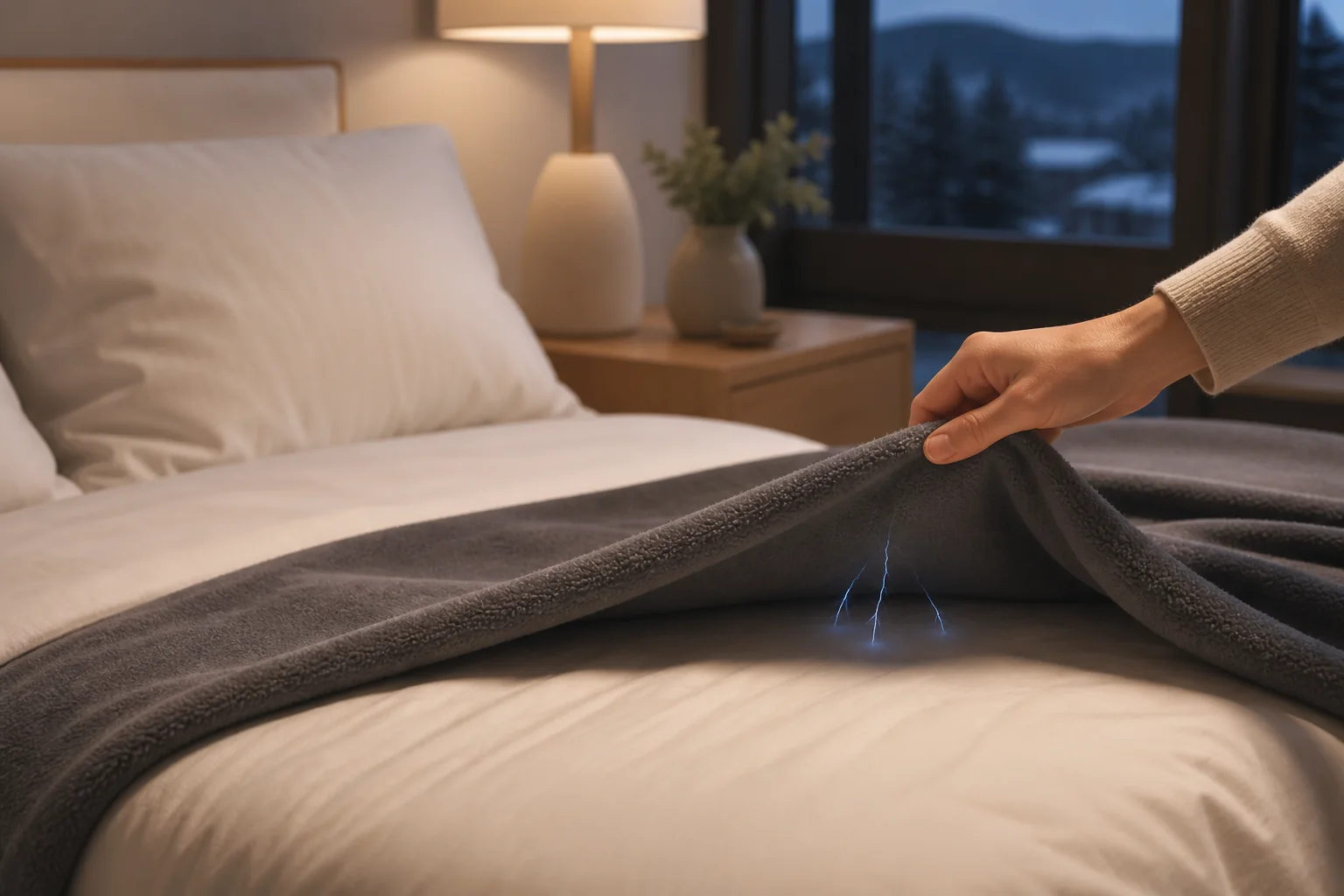
The bed can continue the process. Rolling under a fleece throw, pulling a comforter across a sheet or removing a duvet cover brings different surfaces together and apart. In a dark room, a tiny discharge that is invisible by day may look surprisingly bright.
Related: How to wash a comforter
2. Find the source before changing everything
Start with timing. Static that appears immediately after the dryer points to laundry conditions. Static that builds only after several dry winter nights points more strongly to room humidity and friction during use. A shock tied to one powered object needs electrical troubleshooting instead.
Remove one layer at a time for two nights. Example: use the cotton sheets without the polyester fleece throw, then restore the throw while removing another synthetic blanket. This is not a fabric-quality ranking; it simply identifies which contact pair stores charge in your bed.
Check the sewn-in labels and note every fiber role. A comforter can have a cotton shell and polyester fill, while a duvet cover may be linen over a synthetic insert. The two surfaces actually touching matter more than the marketing name of the whole product.
Finally, use an inexpensive hygrometer instead of guessing that the room is dry. Record morning and evening relative humidity for several days. That separates a persistent environmental pattern from one unusually dry laundry load.
3. Correct the dryer routine first
Do not keep tumbling already-dry bedding just to make it warmer or softer. The American Cleaning Institute lists overdrying as a cause of static buildup in synthetic fabrics, and ENERGY STAR notes that moisture-sensing automatic termination helps prevent overdrying and fabric wear.
Use the care-label-approved cycle and remove the item when it is dry rather than extending a timed cycle. A bulky comforter still must be completely dry inside, so this is not permission to leave fill damp. Pause, feel the center of several chambers and distinguish complete drying from unnecessary extra tumbling.
Separate unlike materials when practical. Whirlpool specifically recommends separating laundry by material and notes that nylon and polyester tend to retain charge longer than cotton. For example, dry a synthetic fleece throw separately from cotton sheets rather than repeatedly rubbing the two together in one load.
If your dryer provides a manufacturer-designed static-reduce or steam option, use it only on eligible loads and according to the manual. Do not improvise by spraying water into a powered dryer or adding homemade metal objects.
- Read every sewn-in care label
- Use enough drum space for free movement
- Stop when the bedding is fully dry
- Separate a high-static synthetic throw from sheets
- Use only manufacturer-approved dryer options
Fix the laundry process before replacing the bedding
Use the complete comforter washing guide to check the label, drum capacity, drying and fill handling from start to finish.
Open the washing guide4. Be deliberate with dryer sheets, softener and sprays
A dryer sheet or fabric softener can reduce static, but it is not automatically suitable for every bedding item. The American Cleaning Institute says these products are formulated to reduce friction or static and should be used as directed. The comforter's care label and the product label both control.
Do not apply liquid softener directly to fabric; ACI warns that this can cause spotting and advises following dilution and dispenser directions. Softener can also be inappropriate for certain flame-resistant textiles. Bedding for children, specialty performance fabric and any item with a restrictive label deserve an explicit compatibility check.
Dryer sheets can leave film on a dryer's lint screen. ENERGY STAR recommends cleaning the lint filter after every load and scrubbing it regularly if dryer sheets are used so airflow is not reduced. That maintenance point matters more than adding extra sheets to a staticky load.
Avoid spraying an unlabeled household mixture over a made bed. A product designed for one garment may not be approved for direct bedding contact, a down shell, a waterproof layer or a heated blanket. If you use an anti-static product, follow its named surfaces, dose, ventilation and drying directions.
5. Adjust room humidity without creating a moisture problem
Very dry air lets charge persist longer, so humidity can be part of the solution—but more is not always safer. EPA's current indoor-air guide recommends keeping indoor relative humidity between 30% and 50%. Its humidifier guidance says not to exceed 50% and to reduce output if windows, walls or nearby materials become damp.
Use a hygrometer and make a small controlled adjustment. Example: if the room repeatedly measures 22% RH, move toward the lower part of EPA's range and watch for condensation. If it already measures 42%, adding a humidifier is unlikely to be the first fix; focus on overdrying and fabric combinations.
Maintain a humidifier exactly as its manufacturer directs. EPA warns that humidifier reservoirs and nearby wet surfaces require proper care. Do not point mist at the mattress, comforter, curtains or wall, and do not let absorbent materials become damp.
Stop increasing humidity if condensation appears. Static annoyance does not justify creating conditions that support mold, damage finishes or leave bedding wet.
Related: How to store a comforter
6. What to do when the bed is staticky tonight
Turn off and remove any unneeded powered or heated bedding before rearranging layers. Move aerosol products, open solvent containers and supplemental oxygen away from the spark area. If the issue is ordinary fabric static, slow separation creates less dramatic discharge than snapping a blanket away quickly.
Remove the suspected fleece or synthetic throw and use the simpler sheet-and-comforter combination for the night. Touching an ordinary grounded metal object away from flammable material may dissipate charge from your body, but do not use plumbing, outlets, electronics or improvised wiring as a grounding project.
Do not soak or mist the made bed. Damp fill can clump, develop odor and require complete label-safe drying. If measured room humidity is low, adjust the room gradually with a properly maintained humidifier rather than wetting the textile.
The next day, inspect labels and correct the dryer routine. A repeatable prevention step is more useful than a one-night trick that adds residue or moisture.
Related: How to fix a lumpy comforter
7. Does fabric choice make a difference?
Fabric pairs differ in how easily they exchange and retain charge, but a fiber name does not guarantee a static-free bed. Whirlpool notes that nylon and polyester tend to hold charge longer than natural fibers such as cotton. Finish, weave, moisture, laundering and which surfaces rub together also matter.
Use a practical comparison rather than a universal material rule. If polyester fleece against microfiber sheets crackles, try the same throw against cotton sheets, then try the sheets without the throw. Change one variable at a time and keep the combination that reduces charge while meeting warmth and care needs.
Natural fiber is not a safety certification, and synthetic fiber is not defective because it develops static in dry conditions. Base replacement decisions on the delivered label, comfort, durability, care and repeated behavior in your actual room.
Related: Polyester vs cotton comforters
8. When static deserves more caution
A brief familiar snap from fabric in a dry room is generally a surface-charge event, not the sustained current associated with a household electrical fault. OSHA's electrical safety material describes ordinary static shock as usually less severe than electrical shock, while emphasizing that static can have serious consequences around enough flammable or combustible material.
Escalate when the context changes: repeated shocks from the same appliance or metal bed part, a damaged electric-blanket cord, hot-plastic odor, visible scorching, sparking from an outlet, supplemental oxygen nearby, or solvent and fuel vapor. Stop using the relevant equipment and obtain qualified advice.
If a person has persistent pain, numbness, skin injury or symptoms that continue away from the bedding, do not diagnose them from this article. Seek appropriate medical advice. Static troubleshooting should remain limited to the textile and environment evidence you can observe.
9. Use this order of operations
First rule out a powered-product or flammable-vapor hazard. Second, identify which layers and which event—dryer unloading or movement in bed—produce the charge. Third, stop overdrying and separate unlike high-static materials when practical. Fourth, check product and care labels before using any softener, sheet or spray.
Only then measure room humidity. When it is below EPA's recommended range, adjust gradually with maintained equipment and stay at or below 50% RH. When humidity is already in range, more moisture is not the answer.
Recheck after three ordinary laundry-and-sleep cycles. If the same powered object still shocks, or static appears with heat, odor or damage, stop DIY bedding changes and use qualified electrical or manufacturer support.
How we built this guidance
We reviewed the current US search results, related queries and four genuine People Also Ask questions for static electricity in bed sheets. The recurring gaps were safety context, a measured humidity ceiling and a way to distinguish fabric static from an electrical fault.
The friction and laundry recommendations use current Whirlpool product guidance, American Cleaning Institute laundry guidance and ENERGY STAR dryer guidance. The humidity range and humidifier cautions come from the US Environmental Protection Agency. The ignition-context distinction uses OSHA electrical and static-hazard material.
We did not evaluate a named anti-static product, claim one fiber is universally static-free or recreate a spark near a flammable atmosphere. This is a source-led troubleshooting sequence; the limitation is that a web article cannot inspect a reader's electrical equipment or verify the composition and condition of every bedding layer.
What helps
- Starts with reversible dryer and layer changes
- Uses measured humidity instead of guesswork
- Separates ordinary fabric static from electrical warning signs
Tradeoffs
- No fiber is guaranteed static-free
- A humidifier requires cleaning and moisture monitoring
- Powered-product shocks need qualified diagnosis
People also ask
Is it bad to sleep with static electricity?
Small, occasional fabric-static snaps in a dry room are usually surface-charge events. Remove flammable vapors and supplemental oxygen, and stop using any powered bedding that repeatedly shocks, smells hot or shows damage. Persistent symptoms or equipment-related shocks need appropriate professional advice.
What fabric causes the most static electricity?
There is no single guaranteed ranking for every bed. Whirlpool notes that nylon and polyester tend to retain charge longer than cotton, especially when unlike materials tumble together. Finish, dryness, friction and the exact fabric pair also affect the result.
What causes static electricity in my bed?
Electrons can transfer when dry sheets, blankets or sleepwear touch, rub and separate. Heated tumble drying, overdrying, synthetic fabric combinations and low room humidity can let that charge build and remain until it discharges.
Should I be worried about static electricity?
An occasional bedding snap is different from an electrical fault. Take extra caution around flammable vapor, fuel, aerosol spray or supplemental oxygen, and stop if shocks repeatedly come from an appliance, outlet, heated blanket or metal bed component.
Sources and editorial method
We cross-check health context, textile definitions and practical guidance against authoritative sources. We do not present generated copy or published specifications as hands-on testing.