
In one sentence
Use GSM to compare fill weight only when the products use similar fill, shell and construction; a higher number generally means more material per square meter, not guaranteed warmth across wool, down and synthetic comforters.
A cautious GSM starting framework
| Listed fill GSM | Typical positioning | Check before deciding |
|---|---|---|
| Below 200 GSM | Very light or warm-room product | Is GSM for fill or shell, and what material is used? |
| 200–300 GSM | Lightweight to moderate | Hot/cold preference, shell airflow and room temperature |
| 300–400 GSM | Moderate to warm in many synthetic ranges | Fill efficiency and whether 350 GSM is marketed as all-season |
| 400–500 GSM | Warm or substantial | Physical weight, overheating risk and washability |
| Above 500 GSM | Very warm/heavy positioning | Cold-room need, storage, machine capacity and return terms |
When GSM helps—and when it misleads
Useful within a like-for-like range
It helps compare two synthetic comforters from the same range when fill material, construction, size and shell remain similar.
Weak across different materials
It cannot fairly rank down, wool and polyester by number alone because their loft, density and moisture behavior differ.
GSM is an areal weight, not a temperature rating
GSM expands to grams per square meter. A 300 GSM fill specification means that one square meter contains 300 grams of the stated fill. Some listings instead quote shell or total textile GSM, so identify exactly what was measured.
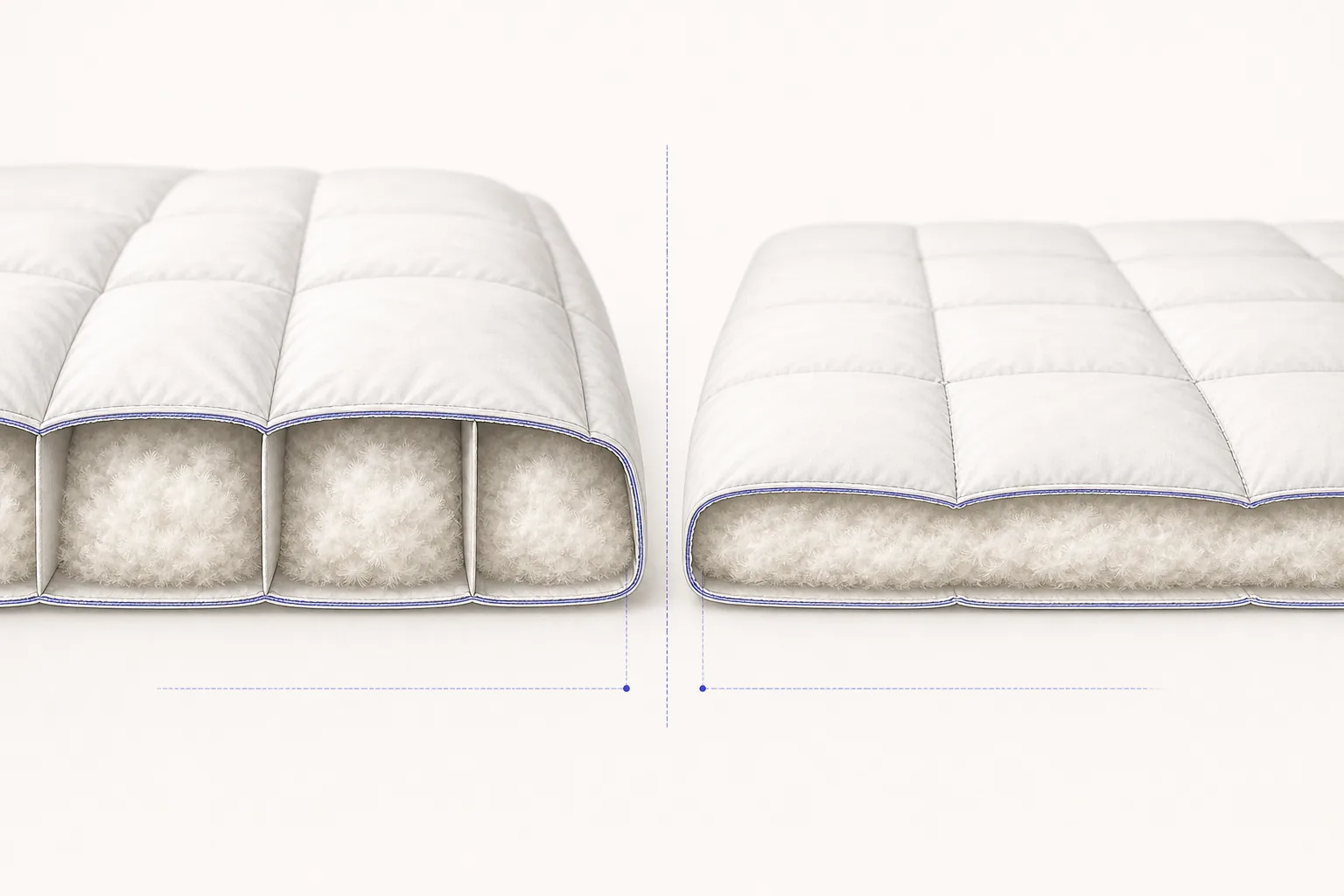
The figure describes quantity per area. It does not directly measure trapped air, thermal resistance or personal comfort. Naturepedic likewise notes that fill type and construction change how equal GSM values behave.
How GSM relates to total fill weight
In principle, total fill weight equals GSM multiplied by the filled surface area in square meters. A 300 GSM comforter covering 4 square meters would contain about 1,200 grams of fill if the specification applies uniformly to fill alone.
Finished dimensions may include hems and unfilled borders, and manufacturers can round specifications. Use the calculation as a plausibility check, not laboratory proof. A listing that gives both GSM and total fill weight should be internally consistent.
There is no universal best GSM for a comforter
Retail guides commonly position lower GSM as lighter and higher GSM as warmer, but their ranges differ. A 200–300 GSM synthetic comforter may be presented for summer or all-season use, while 400 GSM and above is often positioned for colder sleepers.
Bedroom temperature is more useful than the season name. Someone in an air-conditioned warm climate can need different bedding from a hot sleeper in the same city. Use the warmth selector to start with room conditions.
Do not compare synthetic GSM directly with down fill power
Down fill power measures loft in cubic inches per ounce; GSM measures mass per area. They answer different questions. A high-fill-power down cluster can occupy more volume per ounce, so a low physical weight can still create substantial loft.
Wool is denser and usually feels flatter and more substantial. Synthetic fibers vary in shape, crimp and resilience. Compare GSM within the same fill family, then check finished weight and warmth description.

Is 350 GSM too hot for summer?
It can be for a hot sleeper or warm room, particularly with dense synthetic fill and a low-airflow shell. But the number alone cannot settle it: a maker's fill, chamber design and stated warmth tier matter.
If summer overheating is your main concern, prefer a genuinely lightweight tier with clear returns instead of using 350 GSM as a universal cutoff. The summer comforter guide organizes those trade-offs.
The specification stack to record beside GSM
Write down whether GSM applies to fill, shell or total product; the exact fill material; finished dimensions; total weight; warmth tier; chamber design; shell fabric; care; and return terms. Without that context, a large GSM number is mostly marketing shorthand.
Be skeptical when a listing combines GSM, fill power and tog without explaining what each measures. Our UK duvet tog guide covers the thermal resistance convention, while GSM and fill power are material or fill descriptors.
Frequently asked questions
How much GSM is best for a comforter?
There is no universal best number. Around 200–300 GSM is often positioned as light to moderate and 400 GSM or more as warmer, but compare only similar fill types and use room temperature and sleep preference first.
Source: Naturepedic GSM guide, Bedsure comforter GSM guide, American Down and Feather Council terminology
Is 350 GSM too hot for summer?
It may be too warm for a hot sleeper or warm bedroom, especially with dense synthetic fill. The fill type, shell, construction and manufacturer's warmth tier are needed to judge it.
Source: Naturepedic GSM guide, Bedsure comforter GSM guide, American Down and Feather Council terminology
What is the difference between a 500 GSM and 300 GSM comforter?
If material, size and construction are otherwise equal, 500 GSM contains about two-thirds more fill mass per square meter and will usually feel heavier and warmer. Across different fills, that comparison is unreliable.
Source: Naturepedic GSM guide, Bedsure comforter GSM guide, American Down and Feather Council terminology
What is a good GSM for bedding?
For a comforter, a good GSM is one that matches the exact fill and your room conditions. Confirm whether the listing refers to fill or fabric before comparing values.
Source: Naturepedic GSM guide, Bedsure comforter GSM guide, American Down and Feather Council terminology
Sources and editorial method
We checked definitions and practical distinctions against the sources below. Product recommendations live in separate buying guides with their own criteria and disclosures.
The bottom line
GSM is a useful quantity check, not a universal warmth score. Compare it within similar product families and keep fill type, construction, shell, room temperature and total weight in the decision.