In one sentence
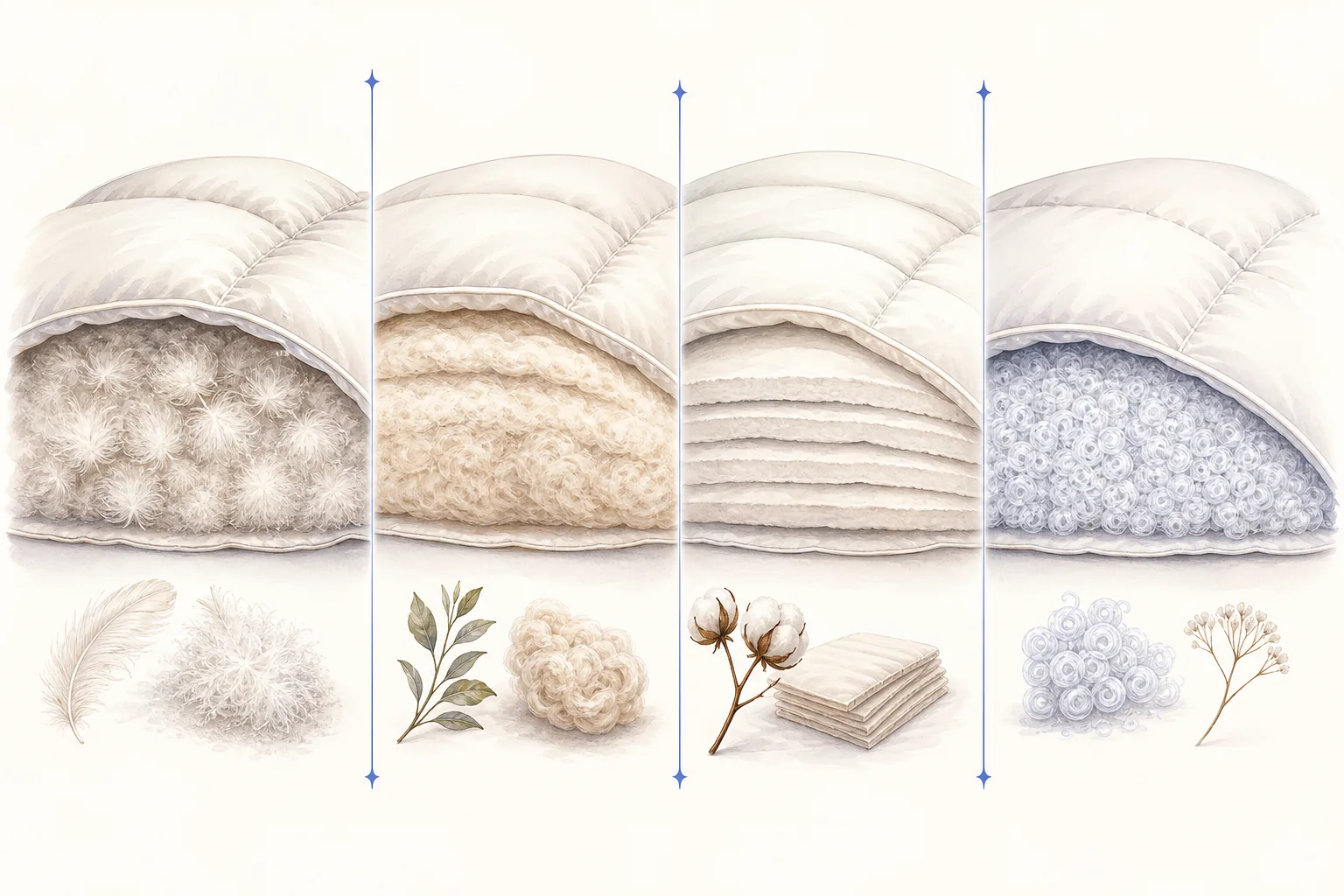
Down vs down alternative comes down to loft for the weight, care and cost: down's natural clusters offer high loft for their weight, measured by fill power; down alternative is usually polyester, often costs less and is easier to wash. Synthetic fill has no equivalent loft test. Choose down for loft and warmth per weight, or consider down alternative for washability, budget or an animal-free fill, after checking the label.
Down vs down alternative at a glance
| Decision | Down | Down alternative |
|---|---|---|
| What is inside? | Natural waterfowl down clusters | Usually polyester; check the actual fiber label |
| How to read warmth specifications | Fill power plus fill weight and construction | Fiber, fill weight or fill GSM and construction; no equivalent fill-power test |
| Washing and drying plan | Often professional cleaning; label controls washing and drying | Often machine washable; label and machine capacity still control |
| Allergy decision | Washed fill is different from raw feathers; mites remain a concern | Synthetic does not guarantee freedom from mite allergens |
| Animal welfare check | Animal-derived; look for verified RDS certification | Check fiber content before assuming animal-free |
| Expected durability | Highly durable with a good-quality shell, per Sleep Foundation | Tends not to last as long as real down, per Sleep Foundation |
| Upfront price direction | Often higher | Often lower |
Is down alternative as warm as down?
It can provide warmth, but the fill name cannot establish equal warmth between two comforters. Down alternative fill usually means polyester made to imitate down; our definition guide covers its materials and labels. Here, the decision is how the finished bedding fits your needs.
REI explains that fill power measures the cubic inches of loft produced by one ounce of down in a lab test. Higher fill power means greater loft and insulation efficiency. It does not tell you the warmth of the finished item: fill amount and distribution also matter. REI's examples concern outdoor jackets and sleeping bags, not measured comforter performance.
Synthetic insulation has no equivalent fill-power test, says REI. You cannot turn a down fill-power number into a synthetic warmth rating. Comparing 700 fill power with a GSM figure is therefore not a valid warmth comparison: one describes loft per ounce, the other mass per area. Our comforter weight guide explains the separate measurements.
For down, ask for both fill power and fill weight for your chosen size. For an alternative, record the fiber, fill weight or fill GSM and construction. The comforter GSM guide explains why GSM is not a universal warmth score. Our buying advice is to compare the full specifications and the maker's warmth description, rather than rank unlike fills by one number.
What if you sleep hot or cold?
Sleep Foundation describes down alternatives as generally less likely to cause overheating. That is its broad editorial observation, not a measured temperature advantage for every synthetic comforter. It should not replace a check of the actual fill amount and construction.
Our practical starting point for a hot sleeper is a lighter warmth tier. For a cold sleeper, look for a tier intended for more insulation, then check the fill specifications. These are buying judgments, not temperature guarantees. The lightweight vs all-season comforter guide explains why tier names are relative to each maker's range.
Do not assume low fill power means cool bedding or high fill power means winter bedding. REI says the amount of down also affects warmth. A lofty fill used sparingly is a different choice from the same fill packed into a warmer design.
Is down or down alternative better for allergies?
Do not assume a synthetic fill solves an allergy problem. Sleep Foundation says unwashed down can contain dust or mold, while many manufacturers wash their down. AAFA also warns that dust mites thrive in down-filled covers and blankets. Cleaning the fill before sale does not establish that bedding will stay free of allergens.
There is a useful caution in the older research. The Asthma & Allergy Center summarizes a small 2002 pillow pilot: commercial processing removed detectable mite allergen from feathers, and the feathers did not accumulate detectable allergen during 90 days of use. It also reports three earlier studies in which synthetic pillows accumulated mite allergen faster, possibly because feather-proof shells were more tightly woven. These are pillow findings, including a short pilot, not proof that down comforters prevent allergies.
Our conclusion for this choice is to treat dust mites as a concern with either fill. A wash routine you can follow and appropriate covers matter more than assuming one category is allergen-free. AAAAI advises removing, washing or covering comforters, plus mite-proof covers for pillows and mattresses. An ordinary duvet cover should not be assumed to be an allergen barrier; our down comforter allergy guide explains that distinction.
The American Down and Feather Council lists oxygen number and turbidity as measures of down cleanliness. They assess organic material and water clarity after testing the fill; they are not a diagnosis or a promise that you will have no symptoms. This is not medical advice. Speak with a doctor about ongoing allergy symptoms and which exposures you need to avoid.
How do washing and drying change the choice?
Sleep Foundation says most down alternative comforters are machine washable, while down comforters often need professional cleaning. These are category tendencies. Read the specific care label before choosing either, including its drying instructions. Our guide to how to wash a comforter covers machine capacity and complete drying.
AAAAI recommends weekly washing of sheets, pillowcases and blankets in 130°F water; AAFA gives similar hot-water guidance for bedding. Use that temperature for a comforter only if its care label allows it. Allergy advice does not override the item's safe-care instructions.
Down also needs routine attention to loft. The American Down and Feather Council says shaking or plumping can restore loft flattened by use. The Company Store notes that down products can shed feathers through normal wear. Our buying advice is to consider the shell and care requirements alongside the fill, rather than judge ownership by softness alone.
Which lasts longer, down or down alternative?
Sleep Foundation calls down highly durable when the cover material is also good quality. It says down alternative fibers tend not to last as long as real down. That is a general direction, not a lifespan promise for either comforter.
The American Down and Feather Council says a higher thread count generally makes fabric more down-proof. Treat containment as part of the purchase: the fill cannot do its job if the shell fails. Our comforter lifespan guide focuses on condition, seams and fill recovery rather than a fixed replacement date.
Down alternative often has a lower upfront cost, according to Sleep Foundation. Our value judgment is to balance that saving against the expected care routine and useful life. The evidence here does not support a universal cost-per-year winner.
What about animal welfare and vegan choices?
Down comes from waterfowl. If you choose it, the Responsible Down Standard is a specific welfare standard to check. Textile Exchange says RDS prohibits live plucking and force-feeding, with third-party certification at each supply-chain stage from the farm and chain-of-custody requirements. RDS-certified down is still an animal material.
Sleep Foundation identifies down alternative as an option for animal-conscious or vegan shoppers, since most options use no animal products. Still, the name alone is not enough. The textile labeling rule in 16 CFR 303.22 requires separate disclosure of filling used for warmth. Check the filling and shell content rather than treating every alternative as vegan.
Which should you choose?
Use your priorities to narrow the fill first. Then compare actual comforters in our best down comforter guide or best down alternative comforter guide. Compare individual models after choosing your preferred fill; the material comparison alone cannot pick a specific model for you.
- Choose down if you value high loft for low physical weight, accept animal-derived fill and can follow the stated care routine. Check fill power, fill weight, shell and any RDS claim together.
- Choose down alternative if lower upfront cost, a machine-washable option or avoiding animal fill leads your decision. Verify the care label and fiber content, and do not expect the category to guarantee cooler or allergy-free sleep.
- If allergies are the deciding factor, ask a doctor about the trigger and choose a manageable cleaning and cover setup. Neither fill name settles that question.
Frequently asked questions
Is down alternative as warm as down?
It can be warm, but equal warmth depends on the actual fill amount and construction. Down provides efficient loft for its weight. A fill name alone cannot establish that two finished comforters are equally warm.
Source: Sleep Foundation: Down vs down alternative, REI: What is down fill power?
Is down or down alternative better for allergies?
Neither name guarantees fewer symptoms. Dust mites can be a concern with either setup. Older pillow studies do not prove comforter performance. Prioritize care you can follow and appropriate covers, and ask a doctor about persistent symptoms.
Source: Sleep Foundation: Down vs down alternative, AAAAI: Cleaning tips for allergy and asthma sufferers, The Asthma & Allergy Center: Feather vs synthetic pillows (2002 study summary), AAFA: Dust mite allergy
Which lasts longer, down or down alternative?
Sleep Foundation says down is highly durable with a good-quality cover and down alternative tends not to last as long. That is a general comparison, not a guaranteed lifespan for a particular comforter.
Can you compare fill power with down alternative?
No. REI says synthetic insulation has no equivalent fill-power test. Fill power measures down loft per ounce, while GSM describes mass per area. Neither provides a direct warmth conversion between down and synthetic fill.
Source: REI: What is down fill power?, American Down and Feather Council: Down and feather terminology
What is the difference between down and down fiber?
The American Down and Feather Council describes down as waterfowl undercoating made of individual down fibers connected at a central point. Fibers are the parts; their connection forms the down structure. This description does not establish a separate definition or quality grade for loose down fiber.
Source: American Down and Feather Council: Down and feather terminology
Is down alternative always vegan?
Do not assume so. Sleep Foundation says most down alternatives use no animal products, but some alternative fills include animal materials. Check the actual filling and shell fiber labels before choosing.
Source: Sleep Foundation: Down vs down alternative, eCFR: 16 CFR 303.22, textile filling labels
Sources and editorial method
We checked definitions and practical distinctions against the sources below. Product recommendations live in separate buying guides with their own criteria and disclosures.
- The Company Store (retailer): Down vs down alternative fill guide
- Sleep Foundation: Down vs down alternative
- eCFR: 16 CFR 303.22, textile filling labels
- REI: What is down fill power?
- Textile Exchange: Responsible Down Standard
- AAAAI: Cleaning tips for allergy and asthma sufferers
- The Asthma & Allergy Center: Feather vs synthetic pillows (2002 study summary)
- American Down and Feather Council: Down and feather terminology
- AAFA: Dust mite allergy
The bottom line
Choose down when loft and warmth for the weight justify its care and animal origin. Choose down alternative when a suitable washable design, lower upfront cost or animal-free fill fits your priorities. Check the exact label: neither fill power, GSM nor the fill name alone tells you how warm or allergy-friendly the finished comforter will be.