
In one sentence
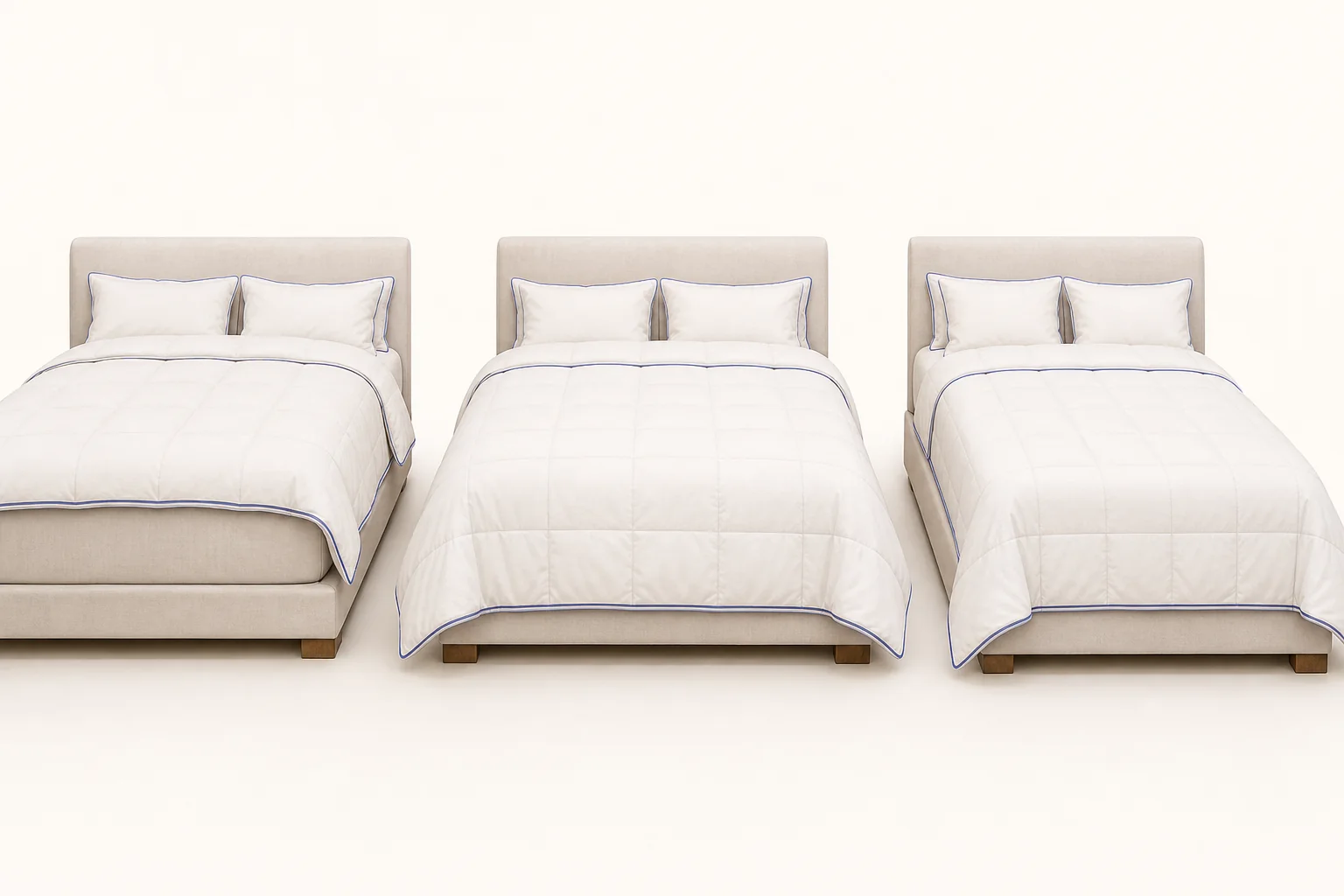
Start with a cover and insert whose finished dimensions are equal or very close and that the maker intends to pair. Measure both pieces flat. Do not use mattress dimensions as cover dimensions, and do not assume US, UK, EU or IKEA size names are interchangeable.
Common US retail ranges—not a binding standard
| Label | Typical cover range (W × L) | Check especially |
|---|---|---|
| Twin / Twin XL | About 68–70 × 86–92 in | Twin XL length and dorm bed drop |
| Full / Queen | About 88–92 × 88–96 in | Whether one combined size fits both beds |
| King / California King | About 104–110 × 92–98 in | Cal King length versus standard King width |
| Oversized / custom | Varies widely | Actual insert match, floor clearance and laundry bulk |
Two different fit questions
Cover-to-insert fit
Compare finished width and length so the insert fills the cover without empty edges or crushed chambers.
Duvet-to-bed coverage
Compare the assembled duvet with mattress width, mattress depth, frame height and desired side drop.
How to use this chart
The ranges summarize common US listings and are not manufacturing standards. Always let the selected product's published dimensions and delivered measurements control.
DFS shows separate intent for cover sizes and strong PAA demand around whether cover and insert must match. This page owns that system fit; the comforter-size chart owns bed-covering ranges more broadly.
Measure the insert after it recovers
Lay the insert flat without stretching, smooth major folds and measure edge to edge at several points. Down and compressible alternatives can vary slightly with loft and use.
Measure the cover separately, inside out if that makes seams easier to identify. Record width and length rather than relying on tag wording.
Calculate the difference in each direction
Cover minus insert gives the total loose fabric. Divide a width difference by two to estimate empty fabric per side when centered. A negative value means the cover is smaller and may compress the insert.
A small deliberate difference can create a fuller look only when the maker recommends the pairing; there is no universal percentage rule across fill types.
Then check the assembled duvet on the bed
Bed coverage uses mattress width plus twice the desired side drop. Mattress depth, foundation exposure and frame clearance influence the visual result.
A cover that fits its insert perfectly can still look narrow on a deep mattress. Solve cover fit and bed drop as two calculations.
Treat international names as separate systems
US Queen, UK King, EU Double and retailer-specific names can map to different inches or centimeters. Convert the actual dimensions, not the label.
One inch equals 2.54 centimeters. Round only for display; keep the original product dimension when deciding whether two pieces match.
Diagnose the symptom before replacing anything
Empty top corners point to excess cover size or unused ties; compressed edges suggest an undersized cover; side migration can come from mismatch or missing attachment points.
After laundering, remeasure only when the label permits washing and the item is fully dry. Shrinkage claims should be evaluated against the maker's instructions.
Frequently asked questions
What are standard duvet-cover sizes?
There is no single binding US standard. Twin/Twin XL, Full/Queen and King/Cal King labels cover overlapping ranges, so compare the exact inches from the selected cover and insert.
Source: The Company Store duvet-cover size guide, Tuft & Needle duvet-cover dimensions, Standard Textile cover size chart
Should a duvet cover be the same size as the duvet?
Equal or closely matched finished dimensions are the safest starting point, unless the maker explicitly recommends a different pairing for fullness.
Source: The Company Store duvet-cover size guide, Tuft & Needle duvet-cover dimensions, Standard Textile cover size chart
What size duvet cover fits a Queen insert?
Use the Queen insert's measured width and length. Many Full/Queen covers fall around the high-80s to low-90s inches, but the exact listing controls.
Source: The Company Store duvet-cover size guide, Tuft & Needle duvet-cover dimensions, Standard Textile cover size chart
Can you put a King insert in a Queen cover?
Usually the smaller cover compresses the King insert and distorts chambers. Only use a different named size when the actual dimensions are compatible and the maker allows it.
Source: The Company Store duvet-cover size guide, Tuft & Needle duvet-cover dimensions, Standard Textile cover size chart
Sources and editorial method
We checked definitions and practical distinctions against the sources below. Product recommendations live in separate buying guides with their own criteria and disclosures.
The bottom line
Match cover to insert in inches first; judge bed coverage second. Size names are convenient filters, never substitutes for two measured dimensions.