
In one sentence
Check the care label, shake the dry comforter from several edges, massage clumps through the closed shell, air it flat, and use a roomy air-fluff or low/no-heat dryer only when the label permits.
Match the symptom to the safest first action
| What you see | Likely reason | Start here |
|---|---|---|
| Flat after unpacking | Compression during shipping | Spread it out, shake it and allow time to expand |
| Soft clumps after washing | Fill is still damp or gathered | Continue label-approved drying and redistribute periodically |
| One empty-looking chamber | Fill shifted within that chamber | Massage it through the intact shell toward the thin area |
| Persistent hard clumps | Residue, incomplete drying or damaged fill | Stop high heat; check dryness and the care label |
| Torn seam or leaking fill | Physical damage | Repair before shaking or tumbling |
When this method fits—and when it does not
Use it for reversible compression
It suits intact down and down-alternative comforters that became uneven after ordinary use, shipping, washing or loose storage.
Stop for damage or uncertain care
Do not tumble a torn, heat-sensitive or dry-clean-only comforter. Repair it or follow professional care instructions first.
Start with the label and a damage check
The correct dryer setting is product-specific. Shell coatings, wool, silk and some decorative trims may rule out tumble drying even when another comforter looks similar. Treat the label as the authority.
Close any fasteners, remove a duvet cover and inspect seams. Tumbling magnifies a small opening, so repair leakage before fluffing. If there is a musty smell, staining or suspected mold, loft is not the first problem to solve.
Redistribute fill without opening the shell
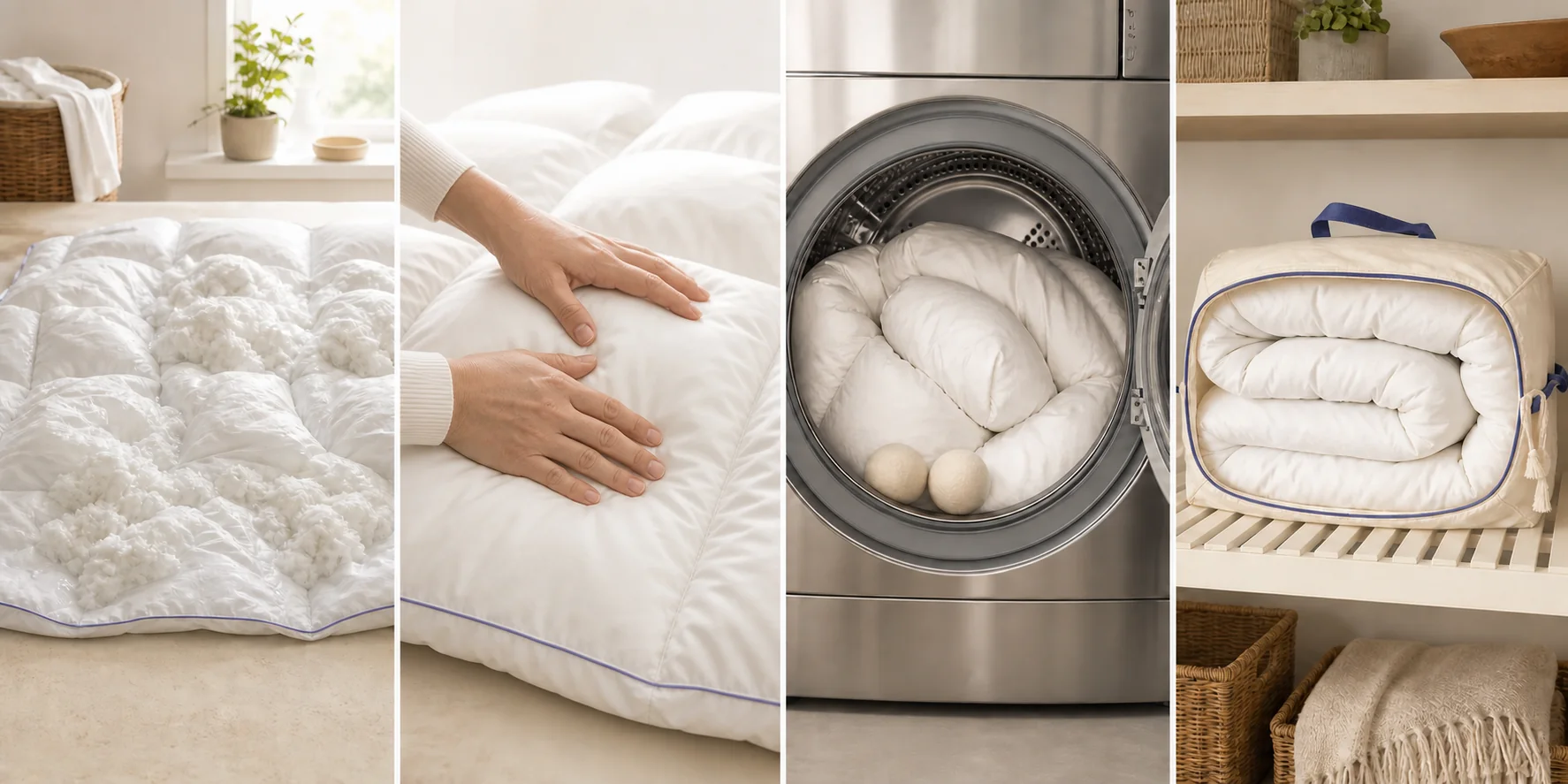
Spread the comforter fully so you can compare adjacent chambers. Hold opposite edges and make short controlled waves rather than violent snaps. Then use flat palms and fingertips to tease a soft clump outward through the fabric.
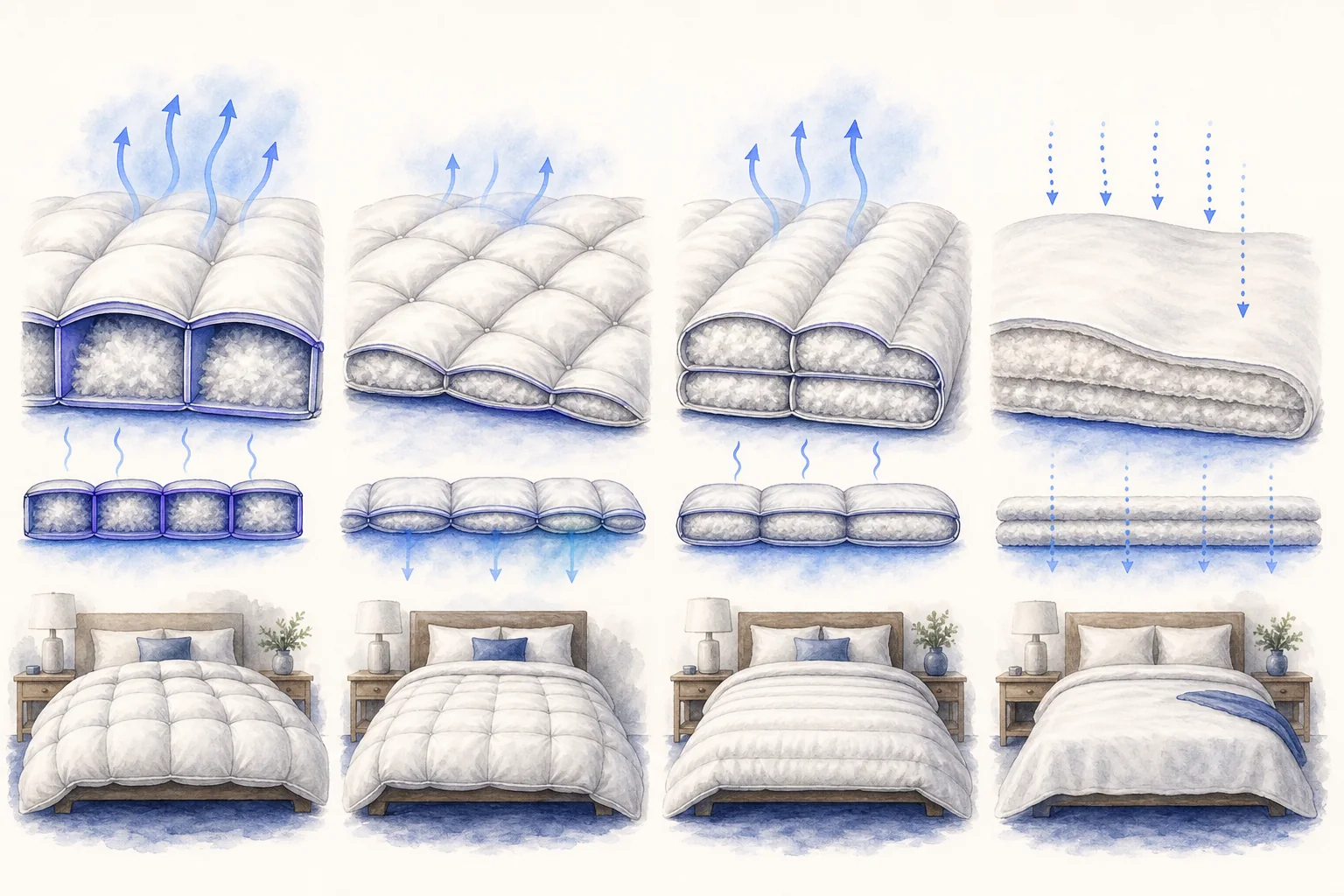
Work from the fullest part toward a visibly thin corner. Baffle walls and sewn-through seams limit how far fill can travel, so do not try to force it across a closed seam. The construction guide explains why chamber boundaries behave differently.
A dryer helps only when it has room and the label allows it
The Company Store recommends a heatless air-fluff cycle when approved, and Whirlpool advises a large-capacity dryer with low or no heat for compatible comforters. The item must lift and fall; a packed drum only rolls a dense bundle.
Clean wool dryer balls can help separate soft clumps. Pause periodically, feel the center and corners for cool damp areas, and redistribute the fill. High heat is not a shortcut: it can damage shell fabric or synthetic fill.
How to fluff a new vacuum-packed comforter
Open the package without cutting toward the fabric. Spread the comforter on a clean dry bed, loosen each folded section and shake it from multiple edges. Shipping compression can temporarily hide the intended loft.
Give it ventilation and time before judging the final profile. Use a label-approved air-fluff cycle only if manual shaking and resting are insufficient. Odor that remains strong or unusual should be handled through the seller's instructions or return policy, not masked with heat.
After washing, flatness often means the fill is not fully dry
A shell can feel dry while moisture remains inside clustered fill. Whirlpool recommends stopping periodically to reposition bulky bedding and continuing until it is completely dry before use or storage.
Our washing guide covers rinsing, machine capacity and drying in detail. Do not store a comforter while waiting for it to finish drying; place it in a ventilated setup and check every chamber.
Know when fluffing cannot restore the original comforter
Repeated compression, broken internal baffles, matted natural fill or heat-damaged synthetic fibers may cause permanent loss of loft. If material moves freely between chambers that were once separated, internal construction may have failed.
Fluffing is maintenance, not evidence that a comforter is still hygienic or structurally sound. Persistent cold spots, leakage, odor or damaged stitching can justify professional evaluation or replacement.
Five steps to restore even loft
- 01Read the sewn-in label and inspect the shell, stitching and corners for tears or leaking fill.
- 02Lay the dry comforter across a clean bed and shake it from the top, bottom and both side edges so fill can settle in several directions.
- 03Press and massage clumps through the closed shell, working inside one stitched chamber at a time. Never open a seam to reach the fill.
- 04Let the comforter rest flat or air in a dry, well-ventilated place. A newly unpacked model may need time to release shipping compression.
- 05If the label allows, tumble it in a dryer large enough for free movement on air-fluff, no heat or the specified low heat, adding clean dryer balls and pausing to redistribute it.
Frequently asked questions
How do I get my comforter fluffy again?
Check the label, shake it from several directions, massage soft clumps through the intact shell and let it air. If permitted, use a roomy dryer on air-fluff or the specified low/no-heat setting with clean dryer balls.
Source: The Company Store refluffing guide, Whirlpool comforter care guide, The Company Store care and storage guide
Can you fluff a comforter in the dryer?
Yes, only when the care label permits and the drum is large enough for free tumbling. Use air-fluff, no heat or the label's low-heat setting rather than assuming high heat is safe.
Source: The Company Store refluffing guide, Whirlpool comforter care guide, The Company Store care and storage guide
How long does it take a comforter to fluff up?
There is no universal time. Light shipping compression may release after shaking and resting, while a washed comforter can require repeated drying checks until every chamber is fully dry.
Source: The Company Store refluffing guide, Whirlpool comforter care guide, The Company Store care and storage guide
How do you fluff out a new comforter?
Remove packaging carefully, spread it flat, shake from all four sides and allow it to ventilate. Use a label-approved air-fluff cycle only if needed.
Source: The Company Store refluffing guide, Whirlpool comforter care guide, The Company Store care and storage guide
Sources and editorial method
We checked definitions and practical distinctions against the sources below. Product recommendations live in separate buying guides with their own criteria and disclosures.
The bottom line
Restore loft with space, airflow and gentle redistribution. The shell stays closed, the care label controls heat, and a comforter is never ready for storage until every chamber is fully dry.