
In one sentence
Read the care label, shake and spread the comforter, smooth it by hand and air it; if permitted, tumble it alone in a roomy dryer on air-fluff, no heat or the label's lowest suitable heat, then remove promptly.
Choose the least aggressive wrinkle method first
| Method | Suitable starting point | Main caution |
|---|---|---|
| Spread and hand-smooth | All intact comforters | Needs time; do not pull seams |
| Dry-room airing | Shipping folds and light creases | Avoid damp or dirty outdoor surfaces |
| Air-fluff/no-heat dryer | Label-approved products | Drum must allow free tumbling |
| Low-heat dryer | Only when label permits | Synthetic fill and coatings can be heat-sensitive |
| Steamer | Only when maker permits | Keep moisture controlled and never saturate fill |
| Iron | Usually avoid on assembled comforter | Direct heat can scorch shell or compress fill |
When this guide fits
Good candidate
A clean, intact comforter with shipping folds or light creases after drying or storage.
Stop first
A damp, stained, torn, embellished, wool- or silk-filled item without clear maker permission for heat or steam.
First identify why the comforter is wrinkled
Sharp parallel folds usually come from packaging or storage. Random set creases often develop when bedding remains tangled or compressed after a wash or dryer cycle. A lumpy surface can instead mean the fill is damp or uneven, which requires complete drying and fluffing rather than cosmetic heat.
If a crease surrounds discoloration, treat the stain before heat. Heat can make some soils harder to remove. A musty smell or cool internal chamber is a drying problem, not a wrinkle problem.
How to unwrinkle without washing, steaming or ironing
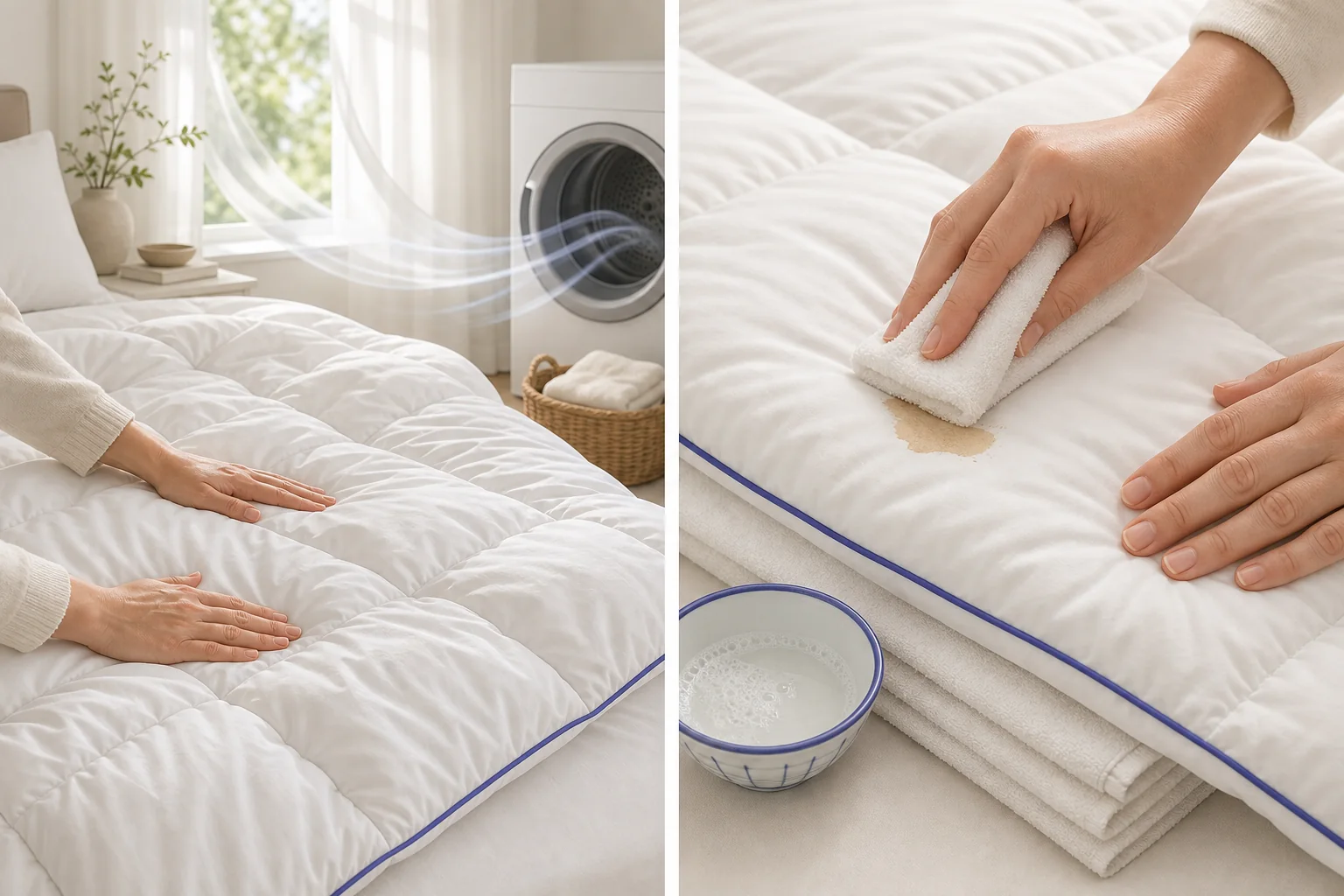
Lay the comforter flat, align the corners and make gentle waves from opposite edges. Smooth each chamber with open palms, then leave the layer exposed to dry room air. Rotate it after several hours so compressed areas are not trapped against the mattress.
This method is slow but compatible with more materials than heat. Our fluffing guide covers redistribution when apparent wrinkles are actually uneven fill.
A roomy low/no-heat dryer can relax fabric
Whirlpool recommends shaking large bedding before drying, avoiding an overloaded drum and using low heat to reduce tangling and creases. For comforters, the sewn-in label remains decisive; air-fluff or no heat is the safest machine starting point when allowed.
Dry the comforter alone, pause to unfold it and remove it promptly. A smaller household drum may roll the item into one tight bundle, reinforcing creases instead of releasing them.
Steam is material-specific, not a universal shortcut
A handheld steamer can relax some cotton or linen shells when the manufacturer permits it, but moisture and heat can reach fill, finishes and adhesives hidden beneath the surface. Test an inconspicuous edge and keep the tool moving at the maker's recommended distance.
Do not steam on the bed when moisture could enter the mattress, and do not use steam to mask incomplete drying or odor. Wool, silk, decorative appliqué and coated synthetics need product-specific instructions.
Do not press an assembled comforter like a flat sheet
An iron concentrates heat and pressure on one small area. That can flatten loft, create shiny marks, scorch shell fabric or damage synthetic fill. Unless the maker explicitly gives assembled-product ironing instructions, use airing or label-approved tumbling instead.
If a removable cotton duvet cover is wrinkled, remove it and follow its separate label. Treating the empty cover is safer and more controllable than ironing through the filled insert.
Prevent deep creases after laundry and storage
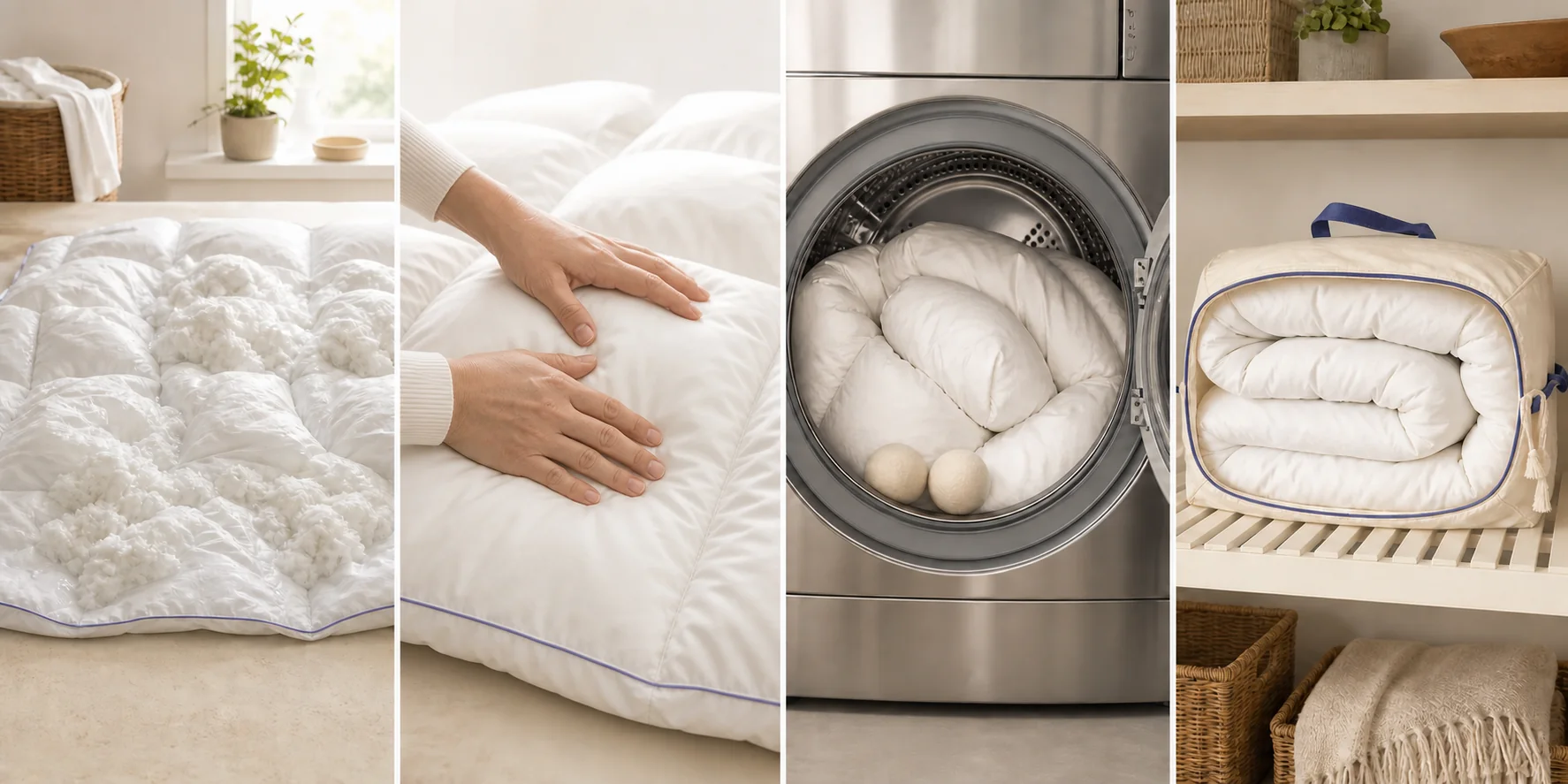
Give the comforter room to wash and dry, pause to untangle it and remove it promptly. Spread it fully until every chamber is dry. Long-term storage should be loose and breathable rather than hard-compressed.
The comforter storage guide explains how heavy stacks and vacuum compression affect loft. A duvet cover can also take most visible creasing while the expensive insert remains protected.
A low-risk wrinkle-removal sequence
- 01Read the shell, fill and care label; inspect for dampness, stains and loose seams.
- 02Spread the comforter across a clean bed, shake it from multiple edges and smooth along—not against—the chamber stitching.
- 03Let it air in a dry ventilated room so compressed fill and fabric can relax naturally.
- 04If permitted, place it alone in a dryer large enough to tumble freely and choose air-fluff, no heat or the lowest label-approved heat.
- 05Pause, shake and reposition it; remove promptly when dry and spread it on the bed rather than leaving it packed in the drum.
Frequently asked questions
How do you fix a wrinkly comforter?
Start by spreading, shaking, hand-smoothing and airing it. If the label permits, tumble it alone in a roomy dryer on air-fluff, no heat or the lowest suitable heat and remove it promptly.
Source: Whirlpool bedding drying guidance, Whirlpool comforter drying guide, FTC textile labeling guidance
How can I get wrinkles out without steaming, ironing or dry cleaning?
Use dry-room airing, gentle hand smoothing and a label-approved air-fluff/no-heat dryer cycle. Time and free movement release many shipping and storage folds.
Source: Whirlpool bedding drying guidance, Whirlpool comforter drying guide, FTC textile labeling guidance
How do you unwrinkle bedding?
Match the method to the item. Removable sheets and covers can follow their own labels; a filled comforter needs lower pressure, enough drum space and care for the hidden fill.
Source: Whirlpool bedding drying guidance, Whirlpool comforter drying guide, FTC textile labeling guidance
Can a comforter be ironed?
Usually avoid direct ironing unless the manufacturer explicitly permits it. Concentrated heat and pressure can damage shell fabric or compress and melt hidden fill.
Source: Whirlpool bedding drying guidance, Whirlpool comforter drying guide, FTC textile labeling guidance
Sources and editorial method
We checked definitions and practical distinctions against the sources below. Product recommendations live in separate buying guides with their own criteria and disclosures.
The bottom line
Use the least aggressive method that works: air, smooth, then label-approved free tumbling. Direct ironing and uncontrolled steam create more risk than most comforter wrinkles justify.