In one sentence
The Scandinavian sleep method means two separate single duvets or comforters on one shared bed. Most couples use two Twin or two Twin XL, says Sleep Foundation. On a Queen or King, length is the tight spot, so Twin XL is often the safer pick. It is a practical setup, not a scientifically tested sleep method.
Two-duvet size math for each bed
| Bed (mattress size) | Each half | Centered overhang and middle overlap (66–68 in wide) | Length left: Twin (86–88 in) | Length left: Twin XL (90–92 in) | What the sources say |
|---|---|---|---|---|---|
| Full (54 x 75 in) | 27 in | (66 − 27)/2 to (68 − 27)/2 = 19.5–20.5 in per side; 39–41 in overlap | 86–88 − 75 = 11–13 in | 90–92 − 75 = 15–17 in | Hard to balance below a Queen (The Conversation) |
| Queen (60 x 80 in) | 30 in | (66 − 30)/2 to (68 − 30)/2 = 18–19 in per side; 36–38 in overlap | 86–88 − 80 = 6–8 in | 90–92 − 80 = 10–12 in | Two Twin usually enough (Naturepedic, brand view) |
| King (76 x 80 in) | 38 in | (66 − 38)/2 to (68 − 38)/2 = 14–15 in per side; 28–30 in overlap | 86–88 − 80 = 6–8 in | 90–92 − 80 = 10–12 in | Two Twin XL fit better (Naturepedic, brand view) |
| California King (72 x 84 in) | 36 in | (66 − 36)/2 to (68 − 36)/2 = 15–16 in per side; 30–32 in overlap | 86–88 − 84 = 2–4 in | 90–92 − 84 = 6–8 in | Not named by the sources; Twin XL is the closer length (our math) |
What is the Scandinavian sleep method?
It is a way for couples to share one bed without sharing a cover. Each person sleeps under their own single-size duvet or comforter, says Sleep Foundation.
The name comes from how popular this setup is in Sweden, Norway and Denmark. It went viral on TikTok in October 2023, after a post by Swedish influencer Cecilia Blomdahl, Sleep Foundation reports. Duvets are the traditional choice, but comforters or blankets work too.
In a 2024 survey by the American Academy of Sleep Medicine (AASM), 10% of people said they had tried the Scandinavian sleep method.
It is not a sleep divorce. In a sleep divorce, partners sleep in separate beds or rooms. In the same AASM survey, 29% of Americans said they had slept in another bed in the same bedroom, or in another space at home, to accommodate a bed partner. With the Scandinavian method you stay in the same bed. Only the covers are separate.
Does the Scandinavian sleep method actually work?
No study has tested it directly. Sleep researchers writing in The Conversation say there is no research that tests two blankets against one. They call it a practical "sleep hygiene hack," not a scientifically tested sleep method.
They also say it fits with healthy sleep habits, so it could reduce the disturbance that comes from sharing a blanket. Sleep Foundation lists the likely gains. Each person controls their own temperature. Nobody hogs the blanket. A partner who goes to bed late or gets up early can get in and out with less disturbance.
Some problems stay. Movement still travels across the mattress, and two duvets do not stop snoring or sleep talking, Sleep Foundation notes. If one partner has restless legs syndrome, it says a motion-absorbing mattress or separate beds may be needed.
If snoring is the problem, AASM says the snorer should talk to a doctor about obstructive sleep apnea. Snoring with choking, gasping or pauses in breathing is a strong warning sign, according to AASM. This page is not medical advice.
What size duvet do you need for each bed?
Sleep Foundation says most couples choose two Twin or two Twin XL duvets, each covering about half of the bed. Naturepedic, a mattress brand, says two Twin duvets usually give enough coverage on a Queen, and two Twin XL duvets fit better on a King. Treat that as one brand's view.
Width is rarely the problem. Our comforter size chart lists Twin and Twin XL comforters at about 66–68 inches wide. Two of them add up to 132–136 inches. That is more than twice the width of a 60-inch Queen.
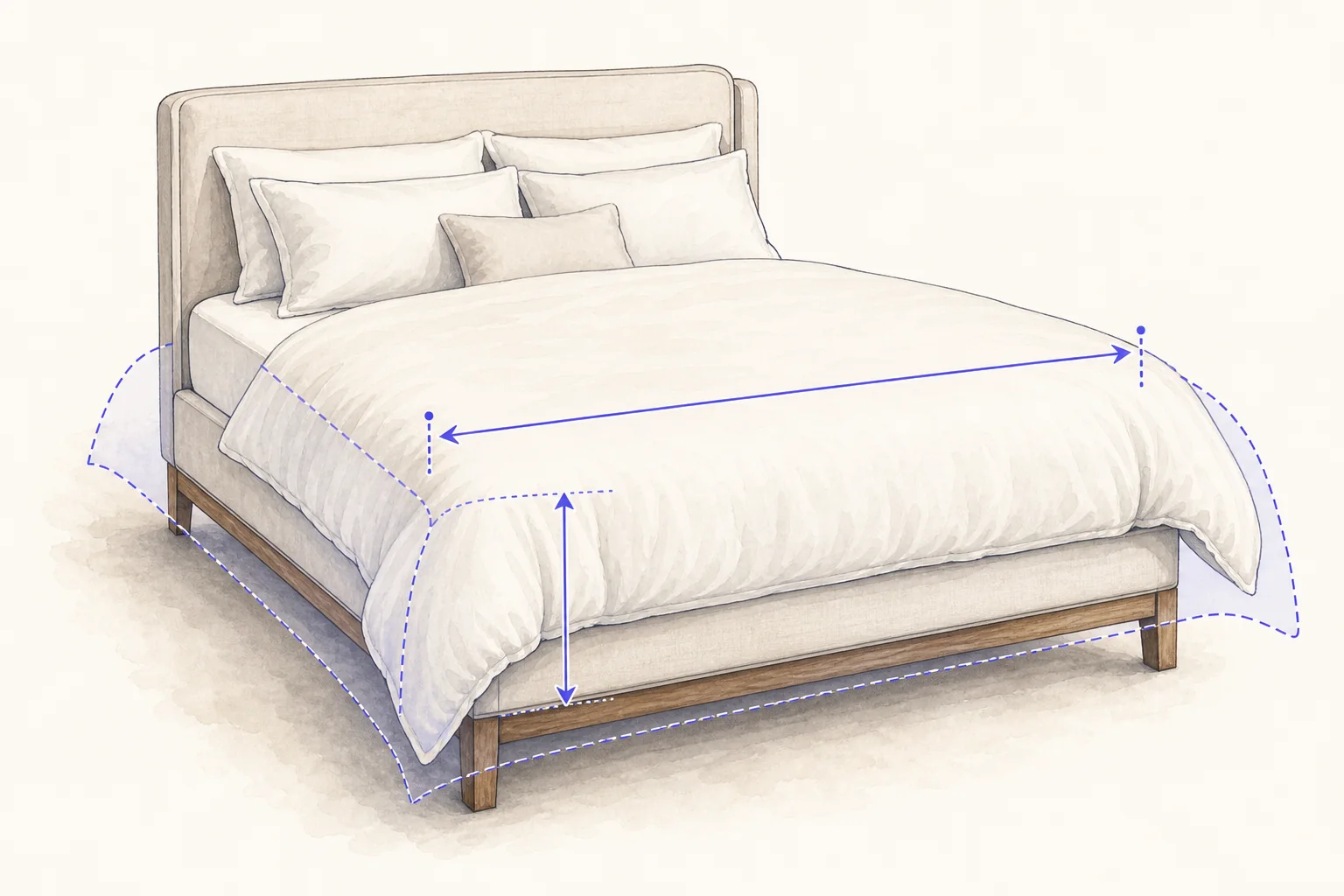
Here is how we did the math in the table. We assume each duvet lies flat and is centered on its sleeper's half of the bed. Then it hangs the same amount past the outer edge and past the middle: (duvet width − half-bed width) / 2. On a Queen, each half is 30 inches, so a 66–68-inch duvet hangs 18–19 inches on each side. In the middle, the two duvets overlap by 36–38 inches. On a King, each half is 38 inches, so the overhang is 14–15 inches and the overlap is 28–30 inches.
Want less drop at the outer edge? Slide both duvets toward the middle. Every inch you take off the outer drop adds two inches of overlap. These are flat-bed numbers. A deep mattress leaves less fabric below the edge.
Length is the tighter limit. A Queen and a King are both 80 inches long. A Twin comforter at 86–88 inches leaves 6–8 inches for the foot of the bed and any tuck. A Twin XL at 90–92 inches leaves 10–12 inches. So on a Queen or King, Twin XL is often the safer length. Twin can still work on a Queen if you do not need much at the foot.
A California King is 72 x 84 inches. That extra length leaves only 2–4 inches with a Twin and 6–8 inches with a Twin XL. Twin XL is the closer fit, and it is still short for a deep tuck.
A Full bed, at 54 x 75 inches, is the hard case. Each half is only 27 inches wide, so the duvets overlap by 39–41 inches. The Conversation warns that on a bed smaller than a Queen, two covers can be tough to balance without one sliding off. Sleep Foundation suggests letting them overlap in the middle, buying smaller duvets, or moving to a larger bed.
Size names vary by brand. Measure your mattress and check each duvet's listed width and length. If your bed is two mattresses, our split king guide covers that setup. If you are choosing between the two sizes, our Twin vs Twin XL guide compares them.
How do Scandinavians make their beds?
Sleep Foundation describes a fitted sheet and two duvets side by side, and says the method typically does not use a top sheet. Naturepedic also recommends skipping the top sheet. Our top sheet guide covers that choice in more depth.
Each person uses a duvet with a removable, washable cover, Naturepedic says. So you need two covers, one per insert. Our duvet cover size chart shows how to match a cover to the insert.
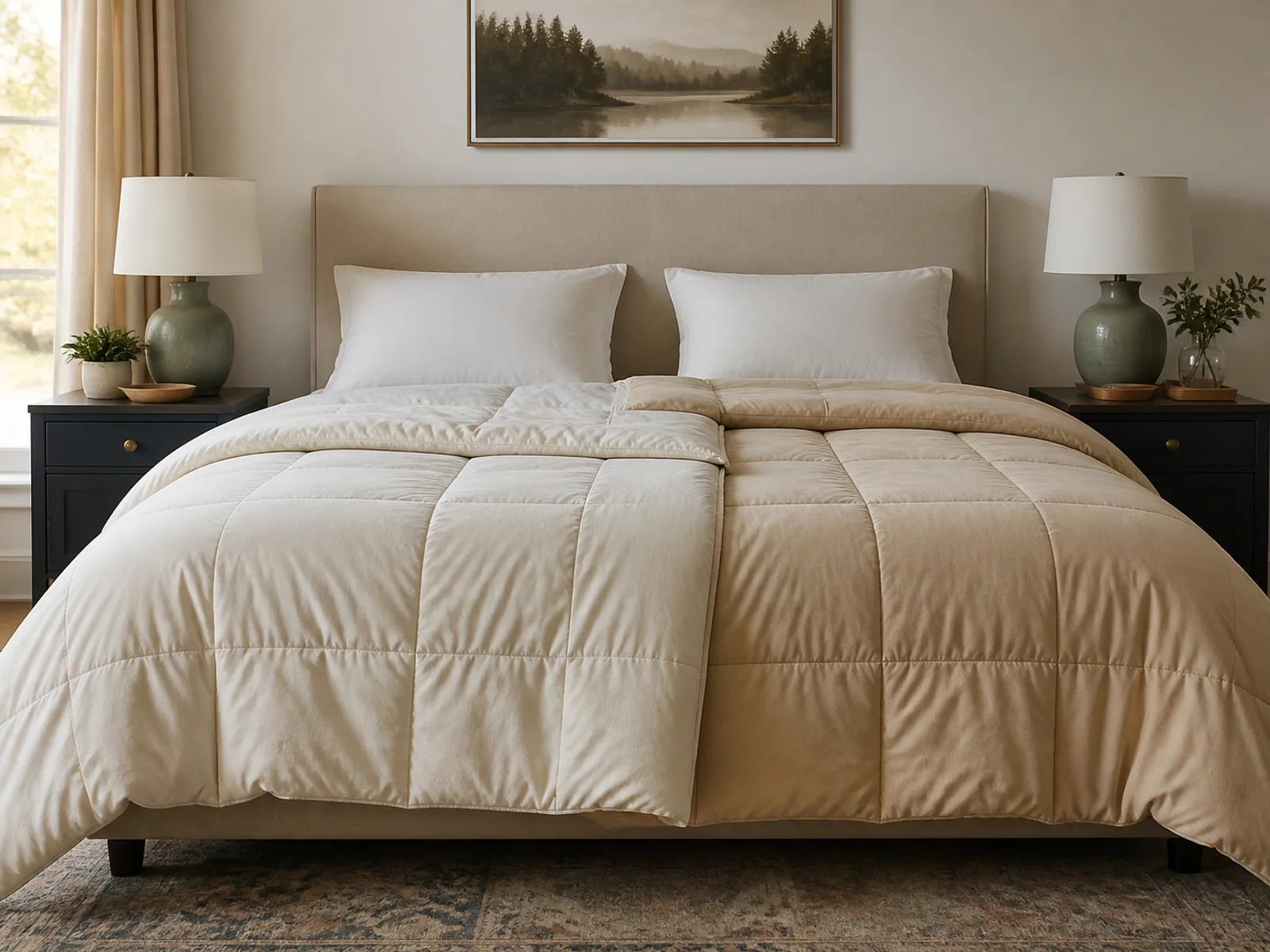
Sleep Foundation says the duvets may overlap a little in the middle, and you can tuck them in at the foot so they stay in place. For a neater look during the day, fold each duvet in half lengthwise, or lay a throw or quilt over both. Two matching duvets also hide the split.
Can each person use a different warmth?
Yes. That is the core idea. Sleep Foundation says hot sleepers may prefer a thinner duvet with less fill, or just a thin blanket. Cold sleepers may prefer a thick, heavy duvet.
The Conversation explains why partners differ. Body temperature at night varies with age, body composition, hormones and whether you are a morning or evening person. Hot sleepers tend to prefer light, breathable fabrics. Cold sleepers lean toward heavier, insulating ones.
The two duvets can share a size and cover style and still have different fills. That keeps the bed looking even while each person gets their own warmth. Our comforter weight guide, linked below, explains fill weight and warmth.
What are the downsides of two duvets?
Cuddling is harder. Two people do not fit under one small duvet, says Sleep Foundation. It suggests cuddling first, then moving under your own duvet to sleep.
The bed looks less tidy, with a visible seam down the middle. A throw, a quilt or folding the duvets lengthwise helps. Small beds are tricky too. See the Full bed math above.
There is more laundry. Two duvets mean two covers to wash and put back on. That follows from the setup itself.
It still costs less than the bigger fix. Sleep Foundation notes that two duvets are less costly than two beds, and you keep one mattress and one set of sheets.
When does one larger comforter still make sense?
If you both like the same warmth and neither of you pulls the covers, one shared comforter is easier to make and easier to cuddle under. That is our reading of the trade-offs above, not a test result.
If you want one comforter with two warmth levels, or want to compare specific comforters for two sleepers, see our guide to the best comforters for couples, linked below. We do not pick products on this page.
How to make a bed with two duvets
- 01Put a fitted sheet on the mattress. A top sheet is optional. Sleep Foundation says the method typically goes without one.
- 02Put each duvet in its own cover. Match each cover to that insert's actual size.
- 03Lay one duvet on each side of the bed, where each person sleeps. Let them overlap a little in the middle so they do not hang off the edges.
- 04Tuck the foot ends under the mattress if you want them to stay put. Check the length left over in the table first.
- 05Add your pillows. If you like, lay a light bedspread, throw or quilt over both duvets to hide the dividing line.
Frequently asked questions
What size duvet do you need for the Scandinavian sleep method?
Most couples use two Twin or two Twin XL duvets, says Sleep Foundation. Both are about 66–68 inches wide. Twin XL is longer, at 90–92 inches versus 86–88. On an 80-inch Queen or King, that leaves 10–12 inches at the foot instead of 6–8.
Source: Sleep Foundation: What is the Scandinavian sleep method?
Does the Scandinavian sleep method work on a queen bed?
Yes. Two 66–68-inch duvets centered on a 60-inch Queen hang about 18–19 inches over each edge and overlap 36–38 inches in the middle. Naturepedic, a mattress brand, says two Twin duvets usually give enough coverage on a Queen. Twin XL leaves more length to tuck.
Source: The Conversation: Will the Scandinavian sleep method help me sleep?, Naturepedic (mattress brand): Scandinavian sleep method
What size duvet do you need for a king bed?
Two Twin XL duvets are the closer fit. Centered on each 38-inch half of a 76 x 80-inch King, a 66–68-inch duvet hangs 14–15 inches over each edge, and the Twin XL length leaves 10–12 inches at the foot. Naturepedic also names Twin XL for a King.
Source: Naturepedic (mattress brand): Scandinavian sleep method
Do you need a top sheet with the Scandinavian sleep method?
No. Sleep Foundation says the method typically does not use a top sheet, and Naturepedic recommends skipping it. Each person uses a duvet with a removable, washable cover. A top sheet is optional if you prefer one.
Source: Sleep Foundation: What is the Scandinavian sleep method?, Naturepedic (mattress brand): Scandinavian sleep method
Is the Scandinavian sleep method the same as a sleep divorce?
No. In a sleep divorce, partners sleep in separate beds or rooms. With the Scandinavian sleep method, you share one bed and only the covers are separate.
Source: Sleep Foundation: What is the Scandinavian sleep method?, AASM: Americans opting for 'sleep divorce' (2024 survey)
Does the Scandinavian sleep method actually work?
It has not been tested directly. Sleep researchers in The Conversation say there is no research that tests two blankets against one, and call it a practical sleep hygiene hack. It can help with blanket hogging and different temperature needs, but it does not stop snoring or mattress movement.
Source: The Conversation: Will the Scandinavian sleep method help me sleep?, Sleep Foundation: What is the Scandinavian sleep method?
How do Scandinavians make their beds?
With a fitted sheet and two duvets side by side, typically without a top sheet, Sleep Foundation says. The duvets may overlap a little in the middle and can be tucked in at the foot. A throw or quilt over both hides the split.
Source: Sleep Foundation: What is the Scandinavian sleep method?
Sources and editorial method
We checked definitions and practical distinctions against the sources below. Product recommendations live in separate buying guides with their own criteria and disclosures.
The bottom line
The Scandinavian sleep method is two single duvets on one shared bed. It is a practical fix for different warmth needs and blanket pulling, not a tested sleep treatment. On a Queen or King, two Twin XL duvets leave the most length to tuck; Twin can work on a Queen if you need less at the foot. Measure the bed and the duvets before you buy.