
Comforter care
How to Remove Stains From a Comforter
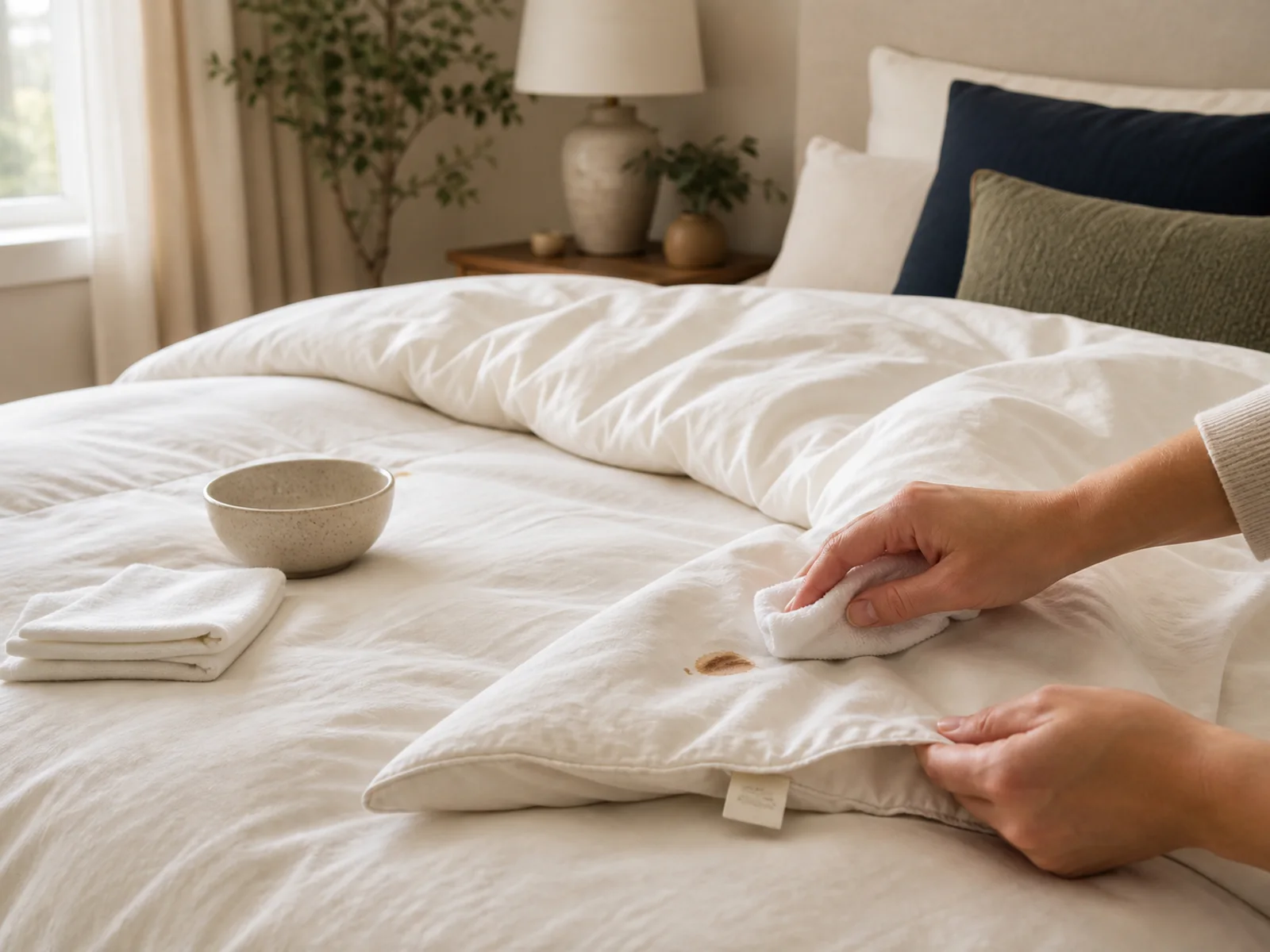
Identify the stain, read the care label and treat the shell with the least moisture that works before deciding whether the whole comforter needs washing.
Disclosure: The Duvet Advisor is reader-supported. When you buy through links on our site we may earn an affiliate commission, at no extra cost to you. We only recommend products after comparing published expert research, verified specifications and clearly cited sources. How this works.
Quick take
Start with the sewn-in care label, then identify the stain and whether it is still on the shell or has soaked into the fill. Blot liquids; do not scrub or flood the comforter. Use cold water for blood and other protein stains, and test any label-compatible pretreatment on a hidden seam. Keep heat away until the mark is gone because drying can make some stains harder to remove. Spot treatment suits a small surface mark; widespread soil, rinse residue or a stain that reached the fill may require the label-approved full wash or a professional cleaner.
Who this guide is for—and its limits
This guide is for a comforter with a localized food, drink, blood, makeup, body-oil or yellow mark. It helps you choose between blotting, pretreating, a full wash and professional care. It does not override the manufacturer's instructions or guarantee that an old, heat-set or chemically altered stain will disappear.
A comforter is not one uniform fabric. The shell, fill, stitching, dyes and decorative trim may each react differently. A cotton shell over polyester batting may tolerate a treatment that is wrong for wool, silk or down. If the label says dry clean only, warns against bleach or limits water temperature, treat that as a boundary.
Stop if color transfers to the cloth, the fabric develops a ring, the coating changes, or the fill becomes wet and matted. A valuable, vintage, silk, wool, heavily embellished or damaged comforter is a sensible professional-cleaner case.
Related: Spot-clean a comforter
1. Make three decisions before applying anything
First, read the label and identify the shell and fill. Second, identify the stain family: protein, tannin, oil, pigment or an unknown mixture. Third, lift the shell gently between your fingers to judge whether the mark is only on the surface or has penetrated into the batting.
Blot a fresh spill from the outside toward the center with a clean white cloth. Do not rub: friction can spread pigment, abrade the shell and push liquid deeper. Put a dry towel beneath the shell only when you can isolate it from the fill without pulling seams or opening the comforter.
Photograph the label before it becomes wet and note whether a dryer has already heated the stain. Work in good light. An unknown tan mark needs a cautious hidden-seam test, not a strong mixture assembled from several household chemicals.
- Label and fiber first
- Fresh or already dried
- Surface shell or wet fill
- Known stain or unknown mixture
- Hidden-seam test before a visible area
2. Treat a fresh coffee, tea or juice spill
Example: coffee lands near the edge of a machine-washable cotton-shell, polyester-fill comforter. Lift off any solids, then blot repeatedly with a white cloth. Use a small amount of the label-compatible laundry pretreatment according to its own directions; do not pour detergent through the shell.
Rinse the treated shell only as the product and comforter labels permit. If the stain and treatment remain confined to the shell, the small-area method may be enough. If coffee reached several fill chambers, a complete label-approved wash is more likely to remove both soil and cleaning residue evenly.
Do not put the comforter in the dryer merely to check progress. Inspect the area in daylight while it is air-dried enough to judge. Repeat a compatible treatment before heat rather than baking in a remaining shadow.
Related: Complete comforter washing guide
3. Use cold water for blood and other protein stains
The American Cleaning Institute's stain guide instructs consumers to soak blood stains in cold water and warns that hot water can set them. For a comforter, isolate the marked shell when possible and use cold water only within the item's care instructions rather than soaking the fill by default.
Example: a small fresh blood spot is limited to a white cotton shell. Blot with cold water, then use a label-compatible enzyme or prewash treatment exactly as directed. Do not use heat until the spot is gone. On silk, wool, down or an item with uncertain dye stability, stop and seek material-specific professional advice.
Dried blood may respond to repeated cold-water treatment, but success is not guaranteed. Avoid chlorine bleach unless both the comforter's label and the bleach label explicitly permit it; white appearance alone does not prove that the shell, stitching or fill is chlorine-safe.
Ready to treat one small surface mark?
Use the step-by-step spot-cleaning guide after confirming the stain, shell and care-label limits.
Open the spot-cleaning guide4. Handle body oil, makeup and greasy marks without flooding the fill
Oil needs a compatible surfactant or pretreatment, but more liquid is not automatically better. Scrape or lift excess cosmetic carefully, blot, then apply only the labeled dose to the shell. Work from the edge inward and keep a clean section of cloth against the stain so lifted oil is not reapplied.
Example: foundation on a washable polyester shell is an oil-and-pigment mixture. A color-safe laundry pretreatment may be appropriate after a hidden-seam test. If the mark spreads into a large halo or the fill feels slick, move to the full label-approved wash rather than repeatedly wetting one patch.
Do not combine chlorine bleach with ammonia, acids or other cleaners. Do not use dish soap as an unlimited shortcut: excess foam can be difficult to rinse from bulky fill and may leave a larger residue ring.
5. Diagnose yellow stains before trying to whiten them
Yellowing can come from body oil, old oxidation, detergent or softener residue, storage moisture, dye change or fill showing through a damp shell. One treatment cannot safely solve all of those causes. Smell, location and history provide better clues than color alone.
Example: yellowing is concentrated at the upper edge where skin touches the comforter. Treat it as likely oily soil and follow the shell's pretreatment and washing limits. If yellowing is widespread after storage and comes with a musty odor or visible spotting, isolate the item and address the moisture problem rather than masking it with fragrance.
For a white down comforter, Clorox publishes a product-specific sequence that includes pretreatment and a full wash, but that advice is conditional on the item's label and compatible products. Do not generalize it to colored shells, wool, silk or every down construction.
Related: Remove odor from a comforter
6. Can an old or dryer-set stain still come out?
Sometimes. Rehydrate a label-washable stain cautiously, apply a compatible pretreatment for its stated contact time, rinse or wash as directed and inspect before applying heat. Several gentle cycles are safer than aggressive scrubbing or an unapproved chemical cocktail.
A dryer-set coffee or oil shadow may be permanent because heat, oxidation or prior chemicals changed the stain or the textile. Set a stopping point: if two careful attempts produce no improvement, professional assessment or accepting a faint mark is safer than weakening the shell.
A ring after spot cleaning may be redistributed soil or cleaner residue rather than the original stain. Do not keep treating the center alone. If the label allows it and the machine is large enough, an even full wash and thorough rinse may be the correct escalation.
7. Change the method for down, polyester, wool and silk
Down needs minimal localized moisture and complete drying if it becomes wet; trapped dampness can clump fill and create odor. Polyester batting is often more forgiving, but heat, coatings and stitching still follow the delivered label. Never assume a washable shell means the whole construction is washable.
Wool can felt or distort with agitation, heat and unsuitable chemistry. Silk can water-spot, lose dye or change sheen. For either material, or for dry-clean-only wording, show the cleaner the stain type and every product already used.
If the shell is torn, do not wash first and hope the seam holds. Repair or professionally assess the opening so fill does not escape and the damaged area does not expand.
Related: Repair a torn comforter
8. Choose spot treatment, a full wash or a professional cleaner
Spot treat when the mark is small, identified, surface-only and the label permits the chosen method. Use a full wash when a washable comforter has widespread soil, a spill inside multiple chambers or pretreatment residue that needs even rinsing—and only when the washer and dryer have enough capacity.
Choose professional care for dry-clean-only instructions, silk or wool, unstable dye, large oil or ink stains, old unknown chemistry, elaborate trim, damaged fabric or fill that cannot be dried safely at home. Tell the cleaner what caused the stain, when it happened and what you applied.
Replace rather than continue treatment if the shell is structurally failing, contamination cannot be removed safely, or persistent dampness and odor remain after appropriate care. This is a hygiene and construction decision, not a cosmetic promise.
Related: Best washable comforters
How we built this stain-removal method
We reviewed current US search demand, the live organic results, related searches and four genuine People Also Ask questions. The intent was distinct from the site's existing spot-cleaning procedure and full washing guide: this page owns stain identification, material boundaries, old and yellow marks, and the escalation decision.
The stain-specific principles use the American Cleaning Institute's current stain guide. Care-label boundaries use FTC guidance, while the comforter examples were cross-checked against current manufacturer instructions from Clorox and OxiClean. Brand instructions are examples, not universal endorsements.
We did not conduct a laboratory stain test, inspect a reader's item or claim guaranteed removal. Exact dyes, finishes, fill and prior heat or chemicals change the outcome, so the delivered care label remains the controlling source.
What helps
- Starts with stain and material diagnosis
- Protects bulky fill from unnecessary soaking
- Gives a clear escalation path
Tradeoffs
- Old or heat-set stains may remain
- Care labels vary by construction
- Wool, silk and unstable dyes may need professional care
People also ask
Can you remove a stain after it's been dried?
Sometimes. Rehydrate only as the care label permits, use a stain-compatible pretreatment for its stated time, and inspect before more heat. Dryer-set or oxidized marks may be permanent; stop if repeated gentle attempts do not improve them.
How do you get old stains out of bedding?
Identify the likely stain and fabric, test a compatible pretreatment on a hidden seam, allow only the labeled contact time, then rinse or wash according to the bedding label. Avoid aggressive scrubbing and mixed household chemicals.
How can I remove yellow stains from my comforter?
First determine whether the yellowing is body oil, residue, storage moisture, dye change or fill showing through. Treat likely oily soil with a label-compatible laundry pretreatment; widespread musty yellowing needs moisture diagnosis and possibly professional care, not automatic bleach.
What is the best bedding stain remover?
There is no universal best product. The right choice must match the stain chemistry, shell fiber, dye, fill and care label. Cold water is important for blood; oily stains need a compatible surfactant, while wool, silk and dry-clean-only items often need specialist care.
Sources and editorial method
We cross-check health context, textile definitions and practical guidance against authoritative sources. We do not present generated copy or published specifications as hands-on testing.