
In one sentence
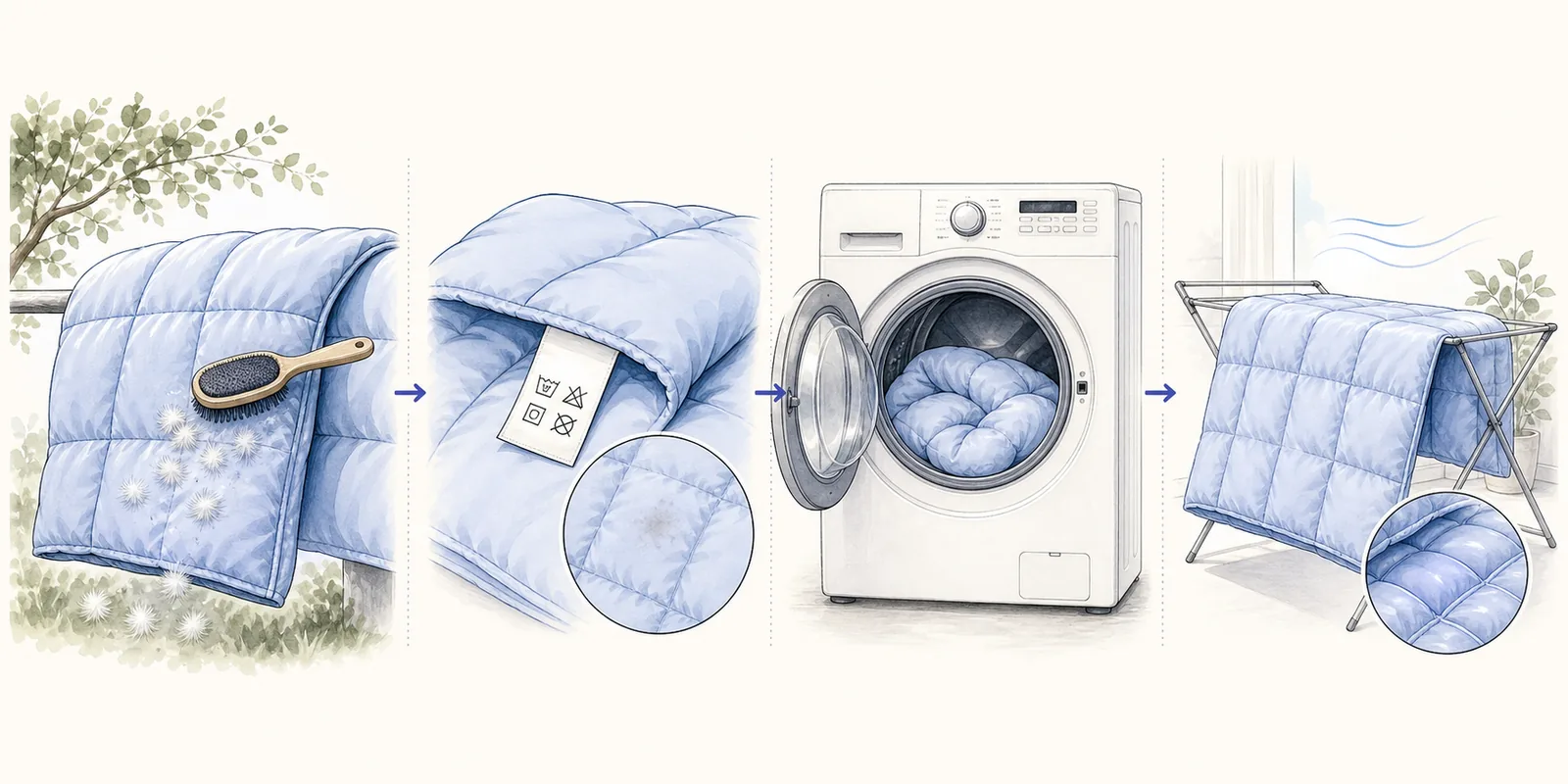
Air a clean dry comforter first; if odor remains, follow its sewn-in label in a sufficiently large machine or use a qualified cleaner, then dry every chamber completely and investigate the washer or storage area before masking the smell.
Match the smell to the safest first response
| Odor pattern | Likely lead | First response |
|---|---|---|
| Appeared directly after washing | Damp fill, residue or washer odor | Keep out of storage; inspect damp chambers and washer |
| Appeared after closet storage | Stored damp or poor airflow | Air outside the closet and inspect for visible growth |
| One local area | Spill, body fluid or pet accident | Isolate and identify the contamination |
| New down smell | Natural material or packaging odor | Air according to maker guidance; confirm return window |
| Visible mold or persistent respiratory irritation | Potential contamination | Stop use and seek qualified cleaning or disposal advice |
Who can handle this at home
Home care can suit a washable, intact item
The label permits it, the odor source is understood, and the comforter fits loosely in both washer and dryer.
Escalate delicate or unknown cases
Dry-clean-only labels, silk or wool, visible growth, leaking fill and repeated odor justify maker or professional guidance.
Diagnose before deodorizing
Musty odor after a wash strongly points to incomplete drying, detergent residue or odor transferred from the appliance. A scent concentrated in one chamber suggests a local source. A whole item that changed in storage points back to moisture and airflow.
Do not spray fragrance over an unexplained odor. It adds residue without removing dampness, biological soil or contamination and makes it harder to tell whether the cause is gone.
Airing is a refresh, not a cleaning substitute
Whirlpool advises airing down bedding as part of routine care. For a clean, dry comforter with mild packaging or storage odor, ventilation may be enough. Support the item broadly and keep it away from rain, pets and prolonged harsh conditions.
Airing cannot remove widespread body soil, urine, vomit, smoke deposits or visible mold. Those need material-compatible cleaning, professional assessment or replacement depending on severity.
Wash only when label and capacity agree
Follow the exact care label rather than a generic fiber rule. A large comforter packed into a small washer cannot rinse well and may leave detergent or soil trapped inside. The full comforter washing guide owns cycle and capacity instructions.
Avoid improvised chemical cocktails. Never mix chlorine bleach with ammonia, acids or other cleaners. For a pet accident, treat the contamination and material—not merely the smell—and verify any enzyme product on the label and a hidden area.

Complete internal drying is the decisive step
Whirlpool explicitly warns that a comforter should be completely dry before use or storage to reduce mold and mildew risk. Redistribute the fill during drying and feel the center, corners and seams for cool damp zones.
If the outer fabric is warm but a chamber remains heavy or cool, drying is not finished. Use a roomy permitted dryer or finish with strong airflow as the label allows; never store it to finish later.
When clean bedding still smells, inspect the machine
A washer with residue or mildew can transfer odor to freshly cleaned bedding. Inspect the gasket, dispenser and drum, follow the appliance manual's cleaning cycle, use the correct detergent amount and remove loads promptly.
If the smell repeatedly returns despite correct cleaning and complete drying, stop repeating cycles. Contact the comforter maker, appliance service or a qualified textile cleaner to isolate the actual source.
A cause-first odor routine
- 01Remove any duvet cover and smell-check the shell, seams and several fill chambers separately.
- 02Read the sewn-in label; identify water, cycle, drying and professional-clean restrictions.
- 03Air a clean, dry item in a ventilated place and inspect for dampness, staining or visible growth.
- 04For local compatible soil, use the spot-cleaning method; do not soak the whole chamber by accident.
- 05For widespread soil, use only the complete label-approved process in a drum with room to move.
- 06Dry on the permitted setting, redistribute fill and check the center, corners and seams—not just the warm shell.
- 07Clean the washer and change storage conditions if the same musty odor returns.
Frequently asked questions
How to remove bad smell from a quilt?
Identify whether the smell is local, post-wash or storage-related, then follow the quilt's care label. Airing can refresh a clean dry quilt; soil or trapped moisture requires compatible cleaning and complete drying.
Source: Whirlpool — washing and fully drying a comforter, Whirlpool — mildew smells after washing, Whirlpool — down comforter care
Why does my comforter stink?
Common leads include damp fill, detergent residue, a dirty washer, storage humidity, body soil, pet contamination or natural down odor. The timing and location of the smell help separate them.
Source: Whirlpool — washing and fully drying a comforter, Whirlpool — mildew smells after washing, Whirlpool — down comforter care
Why don't my comforters smell clean after washing them?
They may be overloaded, poorly rinsed, incompletely dried or washed in an odorous machine. Check the drum capacity, detergent dose, washer condition and internal fill dryness.
Source: Whirlpool — washing and fully drying a comforter, Whirlpool — mildew smells after washing, Whirlpool — down comforter care
How to make your comforter smell good without washing?
If it is already clean and dry, ventilate it according to the maker's guidance and wash any removable cover. Fragrance does not replace cleaning when odor comes from soil, moisture or contamination.
Source: Whirlpool — washing and fully drying a comforter, Whirlpool — mildew smells after washing, Whirlpool — down comforter care
Sources and editorial method
We checked definitions and practical distinctions against the sources below. Product recommendations live in separate buying guides with their own criteria and disclosures.
The bottom line
Treat odor as diagnostic evidence. Air only clean dry bedding, wash only when the label and machine allow, and never return a comforter to bed or storage until its inner fill is completely dry.