
Bedding basics
How to Make a Bed With a Duvet: A Practical Layer-by-Layer Guide
Build a bed that looks intentional and still works at night, from the fitted sheet and pillows to the duvet fold, daily reset and seasonal layers.
Disclosure: The Duvet Advisor is reader-supported. When you buy through links on our site we may earn an affiliate commission, at no extra cost to you. We only recommend products after comparing published expert research, verified specifications and clearly cited sources. How this works.
Quick take
Start with a mattress protector and fitted sheet, add a top sheet only if you use one, place the covered duvet evenly with the opening at the foot, then arrange sleeping pillows before decorative layers. For a relaxed hotel-style finish, fold the duvet back once or accordion-fold it in thirds at the foot. Keep the setup practical: every layer should fit, have a purpose and be easy to remove at bedtime.
1. Before you start: check the duvet system
A duvet bed has two separate pieces: a filled insert and a removable cover. Confirm that the insert is actually inside the cover, that any corner ties or loops are connected, and that the closure is fastened. The cover opening normally belongs at the foot of the bed, where buttons, snaps or a zipper are less likely to touch your face.
The insert and cover should be close in finished dimensions. A cover that is much larger can leave empty fabric at the edges; a smaller cover can compress the insert and create an overstuffed, uneven shape. Do not rely on Queen or King labels alone because dimensions vary. Compare the width and length printed by both makers before assembly.
For example, if a cover is 90 by 90 inches and the insert is 88 by 88 inches, the two-inch difference is distributed around the perimeter and may be manageable. An 86-by-86 insert inside a 92-by-96 cover leaves far more loose fabric, especially at the foot. Our duvet cover size chart explains how to compare the actual numbers rather than the names.
Related: Duvet cover size chart
2. Make the base: protector, fitted sheet and optional top sheet
Smooth the mattress protector first, then fit the sheet over all four corners. Work diagonally if the last corner is tight: secure one corner, move to the opposite corner, then finish the remaining pair. Run your hands from the center outward so wrinkles do not remain trapped under the heavier layers.
A top sheet is optional. If you use one, place its finished or patterned side face down so that side appears when the sheet is folded back. Center the sheet, leave enough fabric at the head for a fold and tuck the foot. You can leave the sides loose for easier movement or tuck them for a more tailored surface.
Choose the contact layer according to your laundry routine. A top sheet can take direct body soil instead of a bare comforter or covered duvet; a regularly washed duvet cover can also serve as the contact layer. The American Cleaning Institute recommends washing sheets weekly, but every filled insert still follows its own sewn-in care label and actual exposure.
3. Center and place the duvet
Stand at the foot, hold the two lower corners and give the covered duvet one controlled shake. Lay it over the bed with equal drop on both sides. Align the top edge near the head of the mattress if it is your only covering, or a little lower if you plan to fold the sheet and duvet together.
Check the bed from the foot instead of correcting one side repeatedly. The center seam, stitched channels or pattern can act as a visual guide. If the left drop reaches 18 inches and the right reaches 12, move the whole duvet three inches toward the right; do not tug only the lower corner, which twists the insert inside the cover.
A deep mattress consumes more of the available side drop. If the duvet barely covers the mattress edge, styling cannot create missing width. Measure the mattress width plus twice the desired drop and compare that total with the duvet width. A larger size may help, but it also adds weight and may exceed your washer or dryer capacity.
Related: Comforter drop-length guide
4. Choose a duvet fold that fits how you sleep
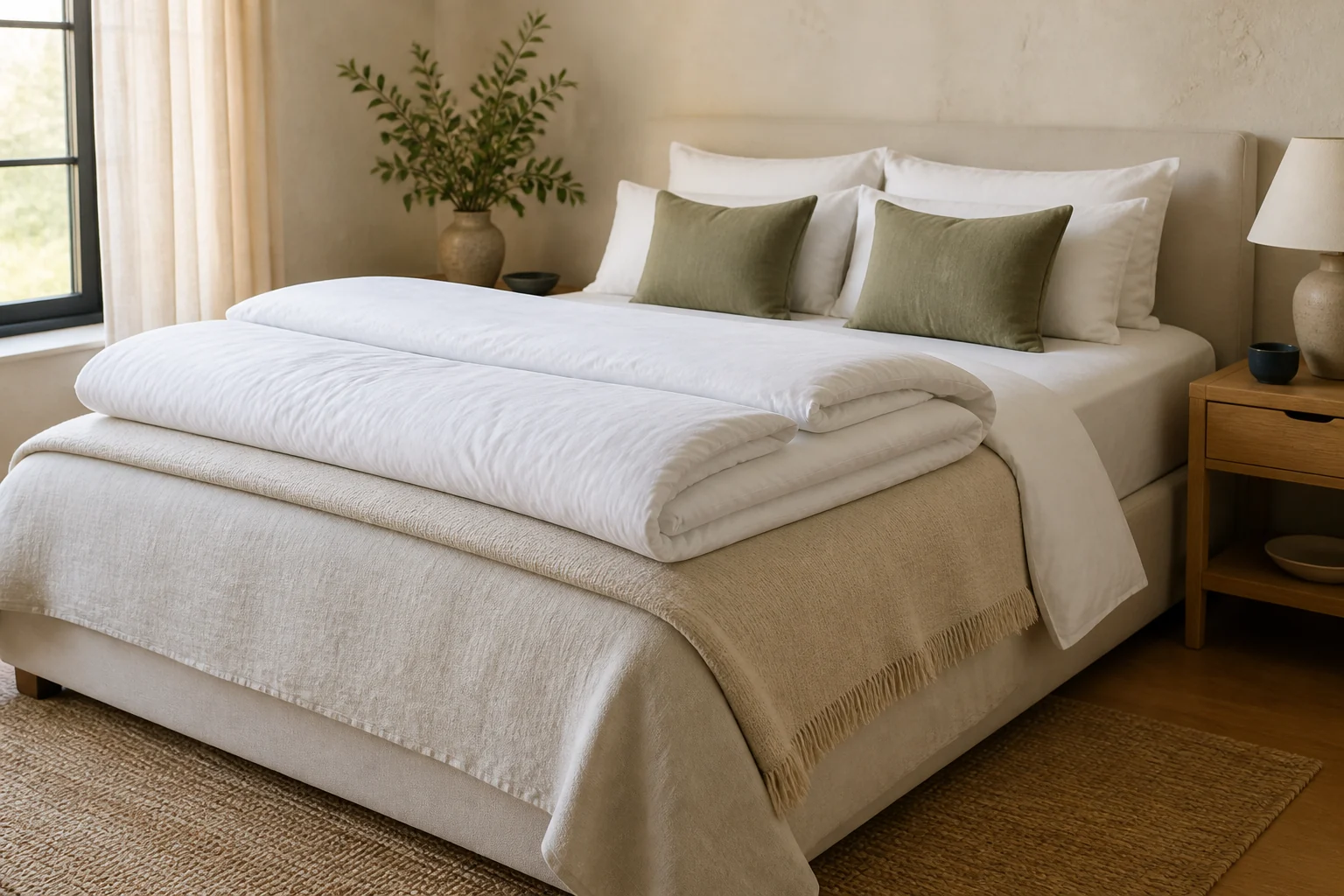
For the simplest everyday bed, pull the duvet flat to the head and fold its top edge back once by roughly the depth of a pillow. This exposes the inside of the cover, creates one clean horizontal line and lets you pull the duvet up without rebuilding the bed at night.
For a fuller hotel-style presentation, fold the duvet back to the middle and then fold that section forward again, creating a loose accordion in the lower half of the bed. Do not compress every fold sharply; the visible loft is what gives the arrangement depth. This is a styling method, not a rule, and it works best when the insert redistributes evenly.
A foot-only fold is practical for warm rooms or daytime display: fold the duvet in thirds and place it across the bottom of the bed. The tradeoff is nighttime effort because the duvet must be unfolded before use. If you make the bed quickly every morning, one broad fold is easier to repeat than a decorative stack of several layers.
Need a cover that fits the plan?
Compare current duvet covers by material, closure, attachment points, dimensions and care—not by styling photos alone.
Compare duvet covers5. Arrange pillows without blocking the bed
Place sleeping pillows nearest the headboard. They can lie flat, stand on their long edge or lean slightly, but keep their openings turned inward for a tidier view. On a Queen bed, two standard or Queen sleeping pillows usually form one functional row; on a King, two King pillows can span more of the width.
Add shams or decorative pillows only after the sleeping pillows are in place. A restrained example is two sleeping pillows at the back, two shams in front and one lumbar cushion centered. That produces depth without creating a nightly pile that has no storage location.
Pillow count should follow routine, not a showroom formula. In a small bedroom, one removable accent pillow may be more usable than five. For a guest bed, leave enough visible sleeping space that a guest can identify the functional pillows and remove the decorative pieces without guessing.
6. Add a blanket or quilt only when it has a job
A thin blanket can sit between the top sheet and duvet for adjustable warmth, while a quilt or throw can lie across the foot as an optional layer. Keep its width centered and let the duvet remain the dominant full-bed covering. Combining different textures works better than stacking several equally bulky filled pieces.
For a summer example, use a fitted sheet, optional top sheet, light blanket and a cool or light-warm duvet folded at the foot. For a colder room, keep the duvet over the sleeping area and add a breathable blanket underneath so either layer can be removed independently. Warmth labels are not standardized across every brand, so judge the full system in your actual room.
IKEA's current duvet guidance likewise tells shoppers to consider warmth level, materials, other bedding and bedroom temperature together. That is more useful than styling by season alone: a high-loft winter insert may look plush in July but still be the wrong functional layer for a warm sleeper.
7. Use a two-minute daily reset
Pull the duvet down briefly after waking so body moisture can disperse, then shake or smooth it according to the maker's instructions. Straighten the fitted sheet, align the duvet from the foot and return the pillows in rows. This small sequence corrects the whole bed faster than perfecting one corner at a time.
If the insert repeatedly bunches inside the cover, open the cover and inspect the attachment points. Reconnect loose ties, match each insert corner to the correct cover corner and check whether the size mismatch is causing movement. Do not keep stretching the cover fabric from outside; that treats the symptom rather than the displaced insert.
Use a practical reset for real households. If a pet sleeps on top, add one washable throw over the preferred area instead of laundering the entire duvet for routine fur. If a child pulls the duvet loose nightly, skip the elaborate accordion fold and use one centered layer that is easy to restore.
Related: Keep a duvet insert from shifting
8. Who this setup works for—and its limits
This method suits people who want a removable washable cover, adjustable visual layers and a bed that can move from daytime presentation to nighttime use. It is especially useful when the duvet is the main top layer and decorative pieces remain limited enough to remove in under a minute.
It is less suitable if removing and refitting a duvet cover is physically difficult, if the chosen insert overwhelms the laundry equipment or if many decorative layers worsen heat and clutter. A finished comforter, quilt or separate-duvet setup may be easier. Couples with different warmth needs can also consider two individual duvets rather than one shared oversized insert.
The final test is simple: live with the arrangement for a week. Notice which layers reach the floor, twist, trap heat, migrate inside the cover or end up on a chair. Remove anything that creates more work than value, then keep the repeatable version rather than the version that only photographs well.
What helps
- A removable cover can simplify routine washing
- The duvet fold changes the look without buying another filled layer
- Independent light layers make seasonal adjustment easier
Tradeoffs
- Insert and cover dimensions must be compatible
- Decorative folds add a daily reset
- Too many layers can add heat, clutter and laundry
People also ask
How do you use a duvet on a bed?
Put the duvet insert inside a correctly sized removable cover, secure any internal ties, close the foot opening and center the covered duvet over the mattress. Use it as the main top layer or fold it at the foot until bedtime.
What is the duvet trick?
The phrase can refer to several methods, most commonly the burrito or roll method for putting an insert into its cover. Turn the cover inside out, align it with the insert, roll them together from the closed end, invert the cover around the roll and unroll. Follow the actual closure and attachment design of your cover.
How do you make a bed look nice with a duvet?
Center the duvet, keep the side drops even, use one intentional fold and arrange functional sleeping pillows before a limited decorative row. Matching dimensions and smooth horizontal lines matter more than adding many accessories.
How do you make a hotel-style bed with a duvet?
Start with smooth fitted and optional top sheets, center the duvet, then fold it back once or into a loose accordion across the lower half. Add aligned sleeping pillows and a small number of shams. Hotels use different systems, so this recreates the visual structure rather than one universal hotel standard.
Sources and editorial method
We cross-check health context, textile definitions and practical guidance against authoritative sources. We do not present generated copy or published specifications as hands-on testing.