
In one sentence
Use thread count only alongside fiber, weave, yarn construction, shell weight and down-proof performance. For many cotton comforter shells, a credible tightly woven fabric matters more than choosing 600 over 1,000; compare the complete specification instead of chasing the highest number.
What thread count can and cannot tell you
| Claim | Thread count helps? | Better evidence |
|---|---|---|
| Woven density | Partly | Weave and yarn construction |
| Warmth | No | Fill type, fill weight and construction |
| Loft | No | Fill power and chamber depth |
| Down leakage | Partly | Down-proof specification and seam quality |
| Cooling | Not alone | Fiber, weave, weight and complete assembly |
| Durability | Not alone | Yarn strength, finishing, care and stitching |
Who should use this metric
Useful for shell comparison
Compare similarly woven, similarly labeled cotton shells from transparent makers.
Ignore number theater
Do not pay more for an extreme count without fiber, yarn, weave and fill details.
Thread count describes threads in woven fabric
The number generally represents lengthwise and crosswise threads counted within a unit area. Counting methods and multi-ply yarn claims can make unlike products difficult to compare.
Knits, linen and specialty shells are not meaningfully judged by the same highest-number contest.
It is not a warmth or fill score
The insulation sits inside the shell. Fill type, fill amount, fill power for down and chamber construction determine far more of the thermal behavior.
Use the comforter GSM guide for synthetic or batting weight and the down-comforter guide for fill power and warmth tiers.
Percale and sateen feel different at similar counts
Percale typically feels crisp and matte; sateen exposes longer floats for smoother drape and sheen. Fiber quality, yarn size and finishing influence both.
A denser shell may reduce airflow or feel heavier, while an appropriate tight weave can help contain down clusters. The correct balance is product-specific.
Down-proofing is a performance requirement
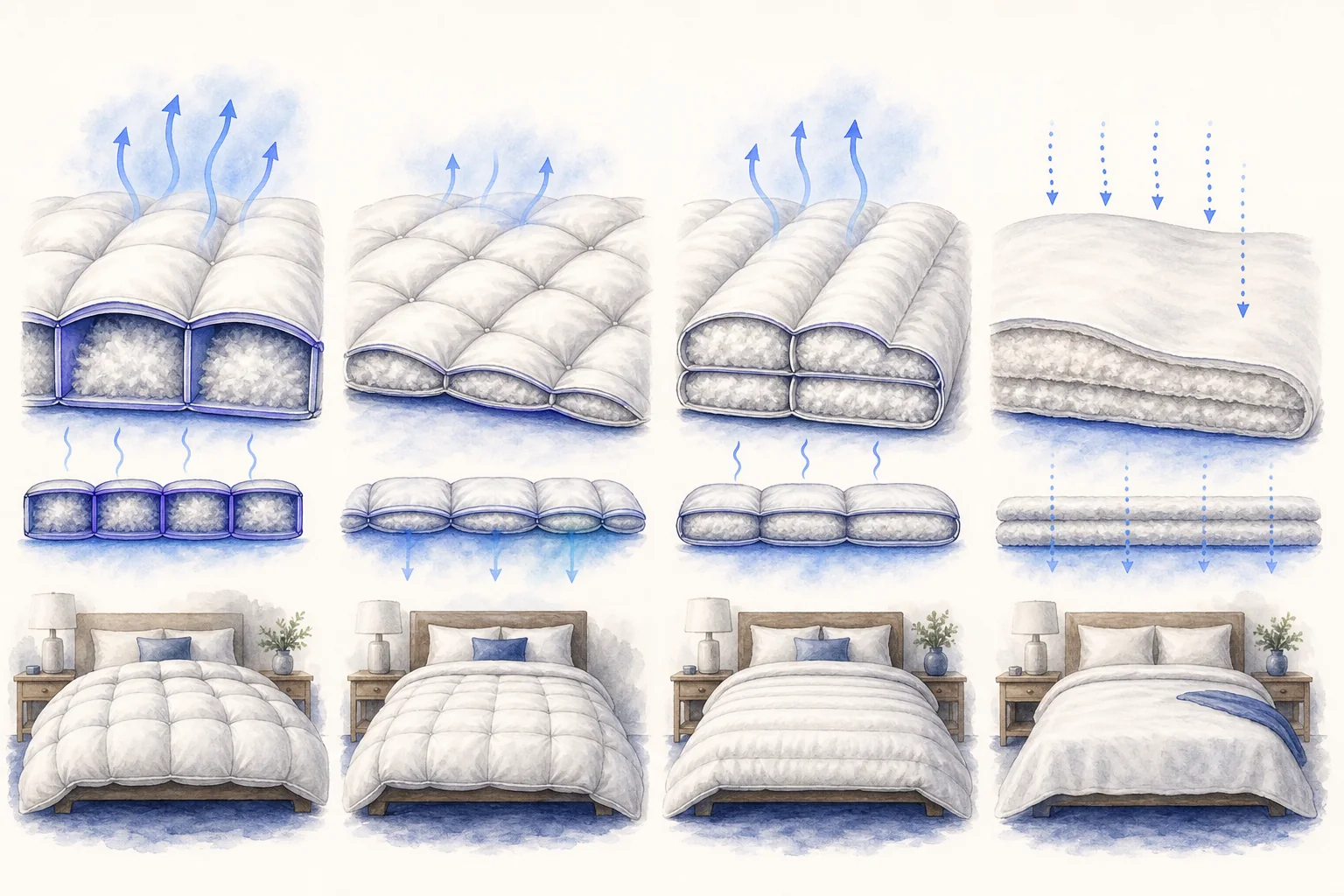
A down comforter needs a shell and seams capable of containing fine clusters. Thread count alone does not prove down-proof performance, and occasional fibers at a seam do not establish the fill percentage.
Look for transparent shell construction, intact baffles and a reliable content label.
Audit six specifications together
Record shell fiber, weave, thread count if given, fill composition, fill weight or warmth tier, and care. That prevents a shell number from hiding an underspecified interior.
Our how-to-choose guide turns those lines into one complete comforter decision.
Frequently asked questions
What's a good thread count for a comforter?
There is no universal target. A credible tightly woven shell with clear fiber, weave and care can outperform a higher-number fabric with vague yarn construction.
Source: FTC textile labeling guidance, CottonWorks cotton home buyer's guide, Downmark quality assurance
Is 500 or 1,000 thread count better?
Not necessarily 1,000. Counting method, yarn ply, fiber and weave can matter more than the headline number.
Source: FTC textile labeling guidance, CottonWorks cotton home buyer's guide, Downmark quality assurance
Which is better, 600 or 1,000 thread count?
Compare like-for-like fabric and the full comforter specification. Neither number establishes warmth, fill quality or durability by itself.
Source: FTC textile labeling guidance, CottonWorks cotton home buyer's guide, Downmark quality assurance
What thread count do five-star hotels use?
Hotels use varied procurement specifications. A hotel label is not a standardized thread-count or comforter-quality benchmark.
Source: FTC textile labeling guidance, CottonWorks cotton home buyer's guide, Downmark quality assurance
Sources and editorial method
We checked definitions and practical distinctions against the sources below. Product recommendations live in separate buying guides with their own criteria and disclosures.
The bottom line
Thread count is one shell descriptor—not a comforter score. Prioritize transparent fiber and weave, appropriate containment, fill specifications, construction and realistic care.